This is the story of a mountain designed to wear people down. Aconcagua is a world away from the beginner-friendly and lush slopes of Kilimanjaro. This is a place of dust, rock, thin air, and relentless winds that make every task harder. The climb has a success rate of 30%. I put in months of preparation to control what I could, and attempt to position myself on the better side of those odds.
Fitness isn’t everything on Aconcagua. It’s how you deal with the accumulation of small things. Dehydration, poor sleep, loss of appetite, headaches, wind, boredom, team dynamics, and the mental grind of weeks with limited oxygen. It humbled me beyond anything I had ever done, but taught me a lot about myself too.
The climb took 15 days through some of the hottest, coldest, and windiest conditions I had ever faced. The base camp has its luxuries, but they don’t detract from this being a harsh and inhospitable place. There’s stress in the challenges, often bringing an emotionally taxing doubt and uncertainty. Still though, when I think of the glowing sunsets on the peak and nights staring up into the silence, I’m reminded how lucky I am to have had this experience.
Background
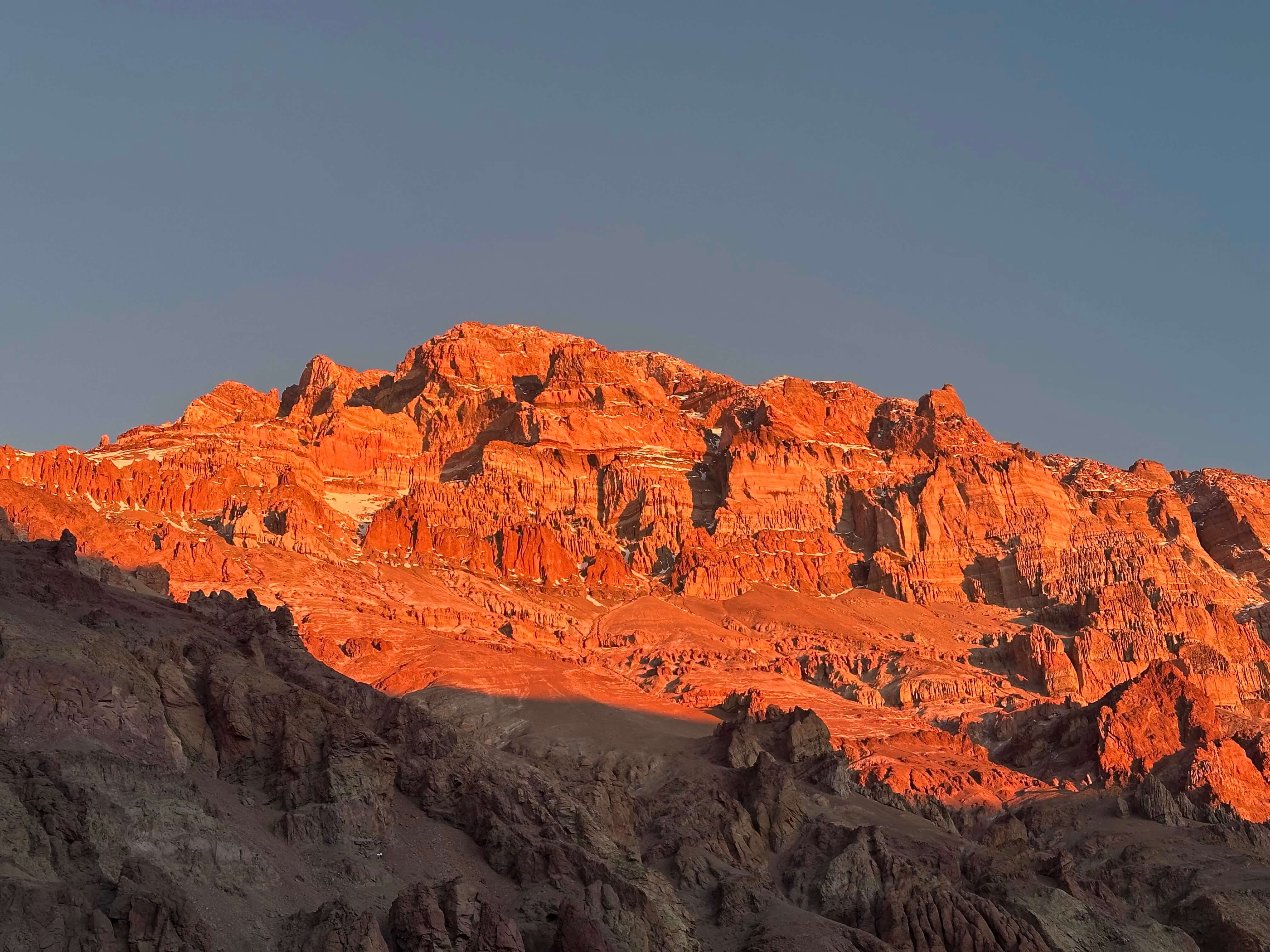
Aconcagua is in the Cordillera Principal, part of the Andes in Argentina. It’s the highest point outside of Asia, and the second highest of the Seven Summits. Unlike the solitary rise of Kilimanjaro from the plains, Aconcagua is the centerpiece of a vast, rugged provincial park, about 15km from the Chilean border. The name comes from the Quechua word Akunkawa, meaning Stone Sentinel.
A frozen mummy discovered at 5,300m suggests the mountain may have been spiritually significant for the Inca Empire, who performed high-altitude sacrifices long before modern mountaineering began. The first recorded summit was in 1897 when Matthias Zurbriggen climbed the Northwest Ridge, now known as the Normal Route. There were over eight failed attempts on that expedition alone. The peak has since attracted mountaineers from all over the world, hoping to test themselves against extreme altitude.
While often labelled a non-technical mountain, Aconcagua is far from a simple hike. Expeditions usually take two to three weeks and involve rough terrain, rockfall and severe weather, as well as the thin air. The lower valleys regularly reach 30°C with no shade, while higher up the Viento Blanco (White Wind) brings gusts over 100km/h and temperatures below -30°C.
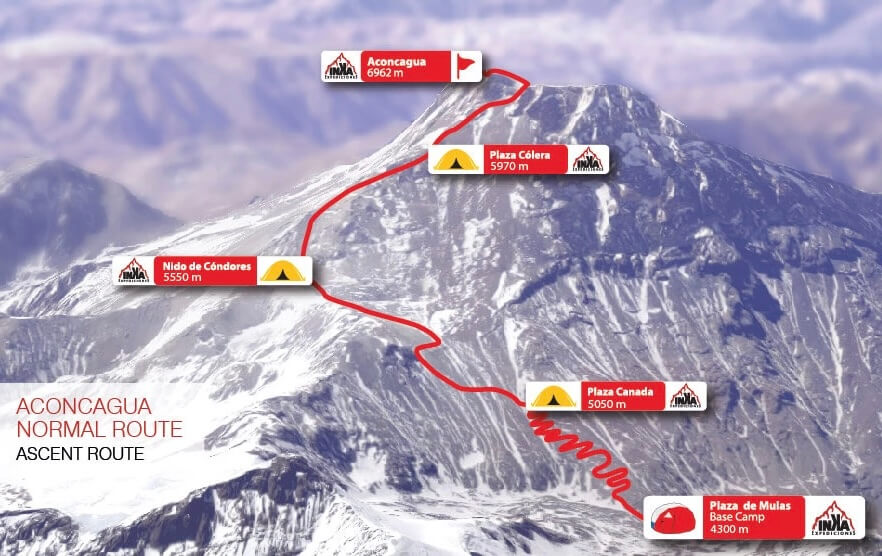
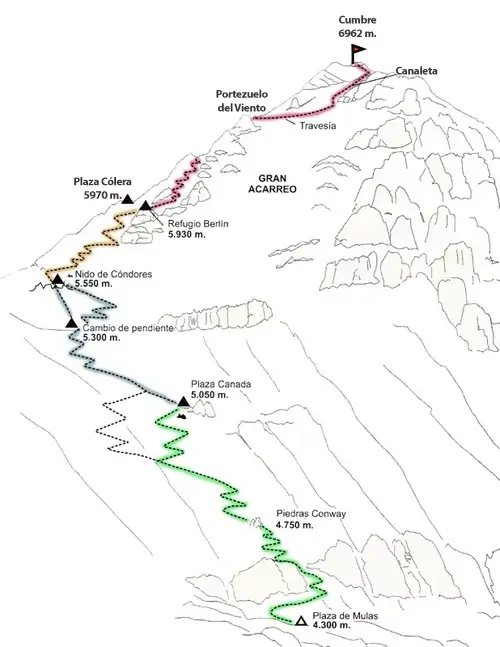
Several camps have been established along the Normal Route. Plaza de Mulas is the base camp, which usually takes 2-3 days to reach. Mules keep this stocked with good food and the comforts needed for recovery between climbing days. Most people use three camps between here and the summit, for acclimatising and when moving towards the peak.
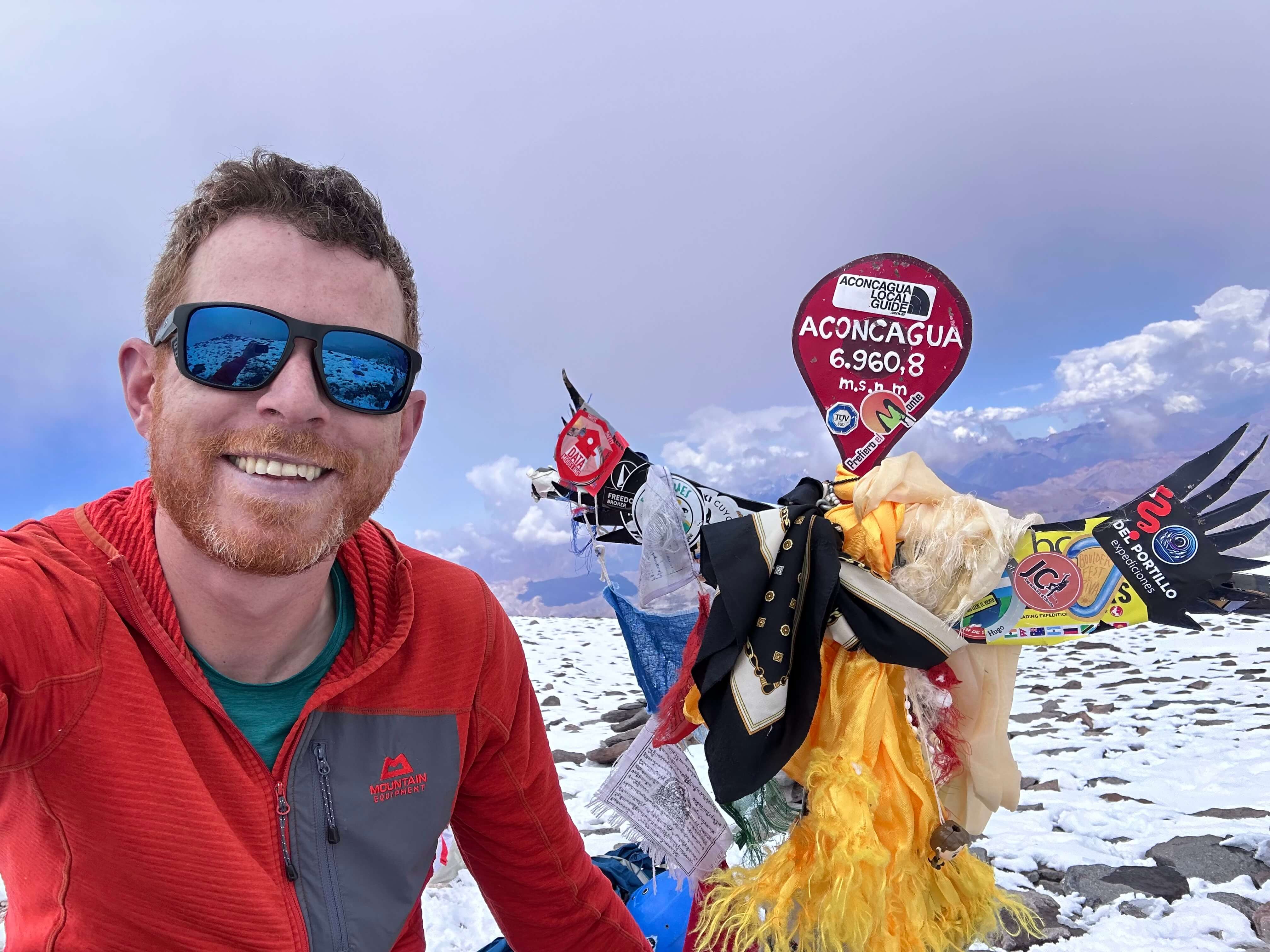
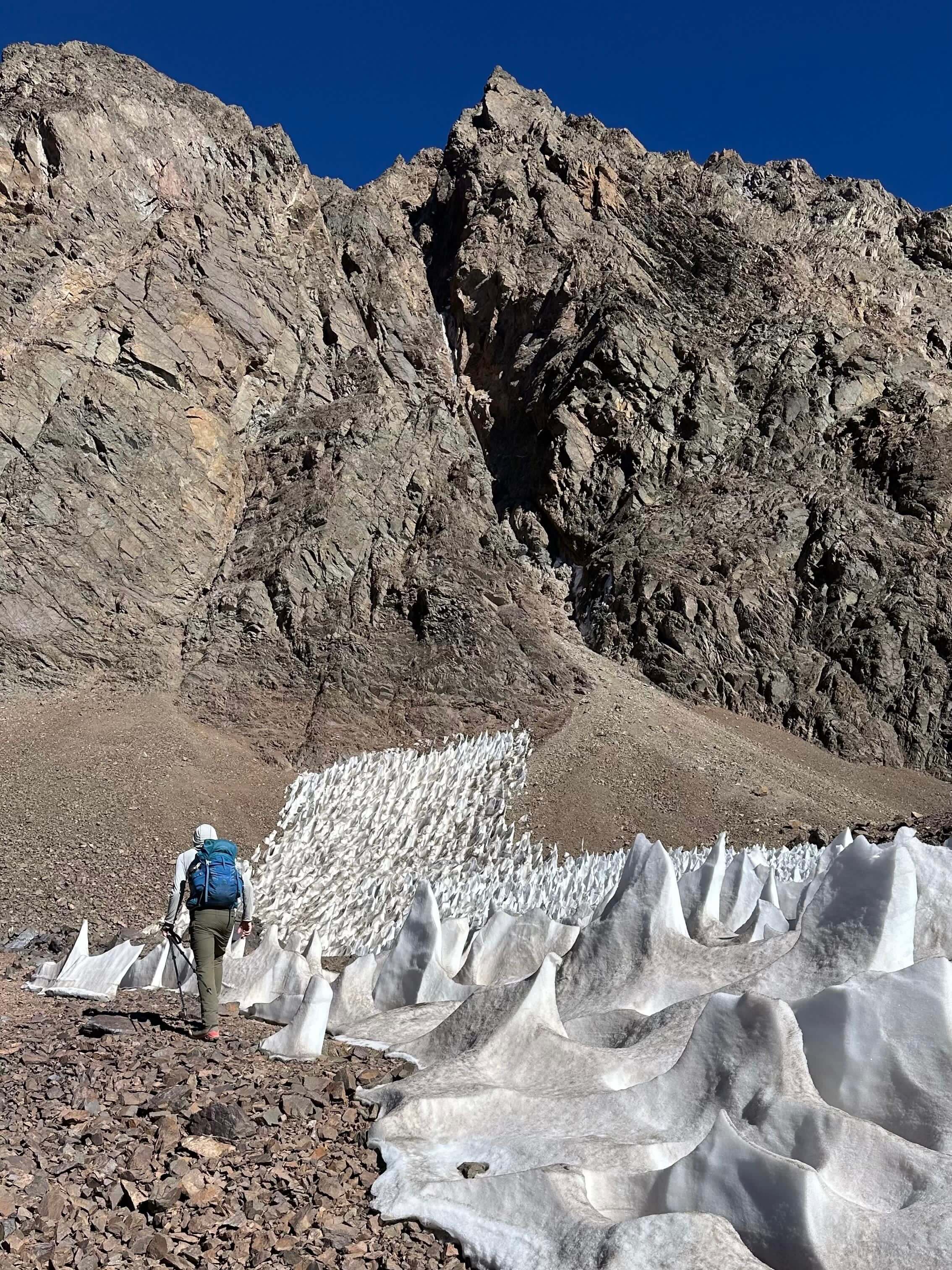
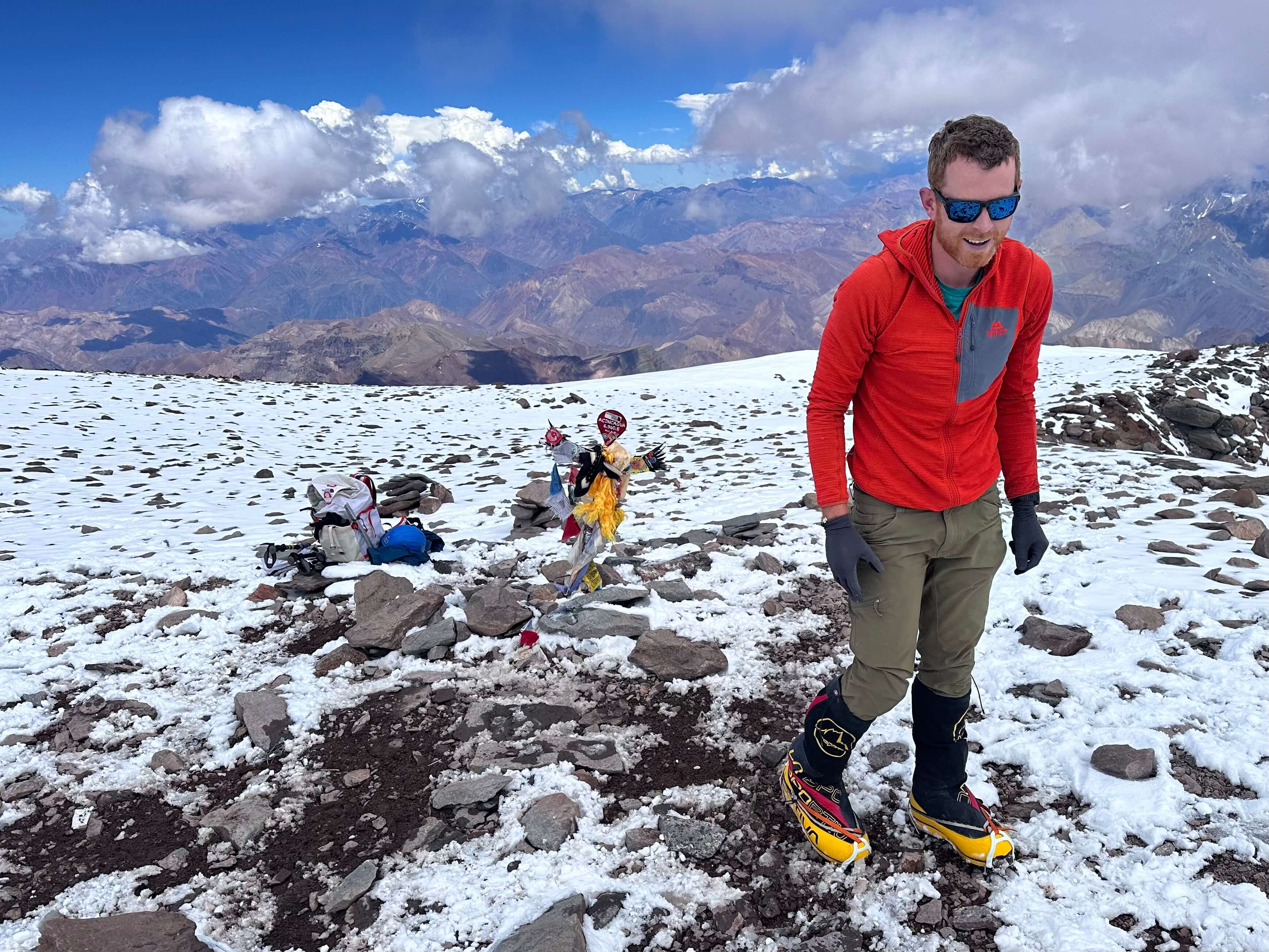
The lower mountain has a stark, desert-like beauty. Dry valleys and dusty plains lead to huge scree slopes and the famous penitentes; giant snow spikes created by intense sun and wind. Above Camp 3 (Cólera), the mountain becomes a world of rock and permanent ice, moving up the ridge and across the La Cueva traverse. The final gatekeeper of the peak is the Canaleta; a steep couloir below the summit ridge, atop which you earn the final rocky scramble to the condor shaped cross on the summit.
Logistics & Planning
It’s possible to climb Aconcagua independently, and many do. You would need a solo permit, self-arranged mules, and usually a simple base camp service from an operator. I’ve met a lot of people who have done it that way, with varying degrees of success and safety. For my first time, that wouldn’t have been the responsible option.
I chose to climb with INKA Expediciones, the biggest operator on the mountain. They charge $4,600 excluding insurance ($180) and climbing permit ($600). Their itinerary is 13 days, but they offer a 15 day version for no extra cost which climbs Cerro Bonete (5,052m) for extra acclimatisation. This was a no brainer for me, but I ended up being the only one in my group of eight who chose it.
INKA is known for having the nicest base camp setup and the best food, but their success rates are below average. Smaller groups with independent guides spend more time on rotations, but I knew I would be arriving acclimatised so thought it should be okay. I paid all my fees and had my park permit over six months in advance.
The logistics include mules to carry the bulk of the expedition equipment to Plaza de Mulas. This makes the approach more manageable, but once you move above base camp the luxury ends. Every tent, stove, sleeping bag, litre of water and kilogram of food has to be carried by you. It’s good to have a guides experience, especially if conditions turn bad, but no one can climb the mountain for you.
Acclimatisation is Key
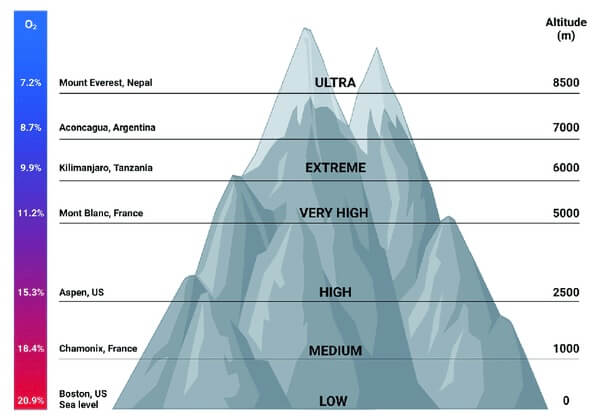
Aconcagua is at the edge of what the human body can tolerate for any meaningful time. At nearly 7,000m, there’s roughly 40% the oxygen of sea level. Air is less dense, so there are fewer molecules in each breath. The body adapts by breathing faster, raising the heart rate, and slowly making red blood cells. The more efficient the body becomes at extracting oxygen, the better you avoid symptoms of Acute Mountain Sickness (AMS).
The best strategy to boost red blood cells is to climb high, sleep low. Climbers do small hikes, or carry food and gear to higher camps, then descend to recover. This allows the body to adapt better. It’s a slow and exhausting process, requiring up to 5L of water a day and lots of food. The people who do more rotations up/down the mountain tend to have better success.
The physical toll of being at altitude is significant though, so there is a balance. Recovery is incredibly slow, appetite fades, and dry air causes deep coughs. Simple headaches can linger for days, and moving too high too soon can lead to HACE or HAPE; life-threatening forms of altitude sickness involving swelling of the brain or lungs. Too many rotations could also leave the body too tired on the summit push, and every plan must be flexible to the weather.
Above 6,700m on the Canaleta, things become surreal. You can feel fine while sitting still, then exhausted by a few steps uphill. Every movement becomes deliberate. Hydration, pacing and patience matter more than fitness. On smaller peaks Diamox (acetazolamide) is used to aid acclimatisation, but it’s avoided on Aconcagua because it can mask symptoms. Here it’s more important to listen to your body.
Below are the relative oxygen levels on other peaks. On any higher mountain, 7,000m is the point where you begin using supplemental oxygen (e.g. Camp 3 on Everest).
Preparation & Training
I first heard of Aconcagua while climbing Kilimanjaro in 2022. Slowly the mountain became the centerpiece of a much larger plan. I started a gap year in July 2024 with Elbrus, for which I bought most of the expedition gear I’d need and learned many of the necessary skills. In the months afterwards I backpacked through Central America and South America while acclimatising specifically for Aconcagua.
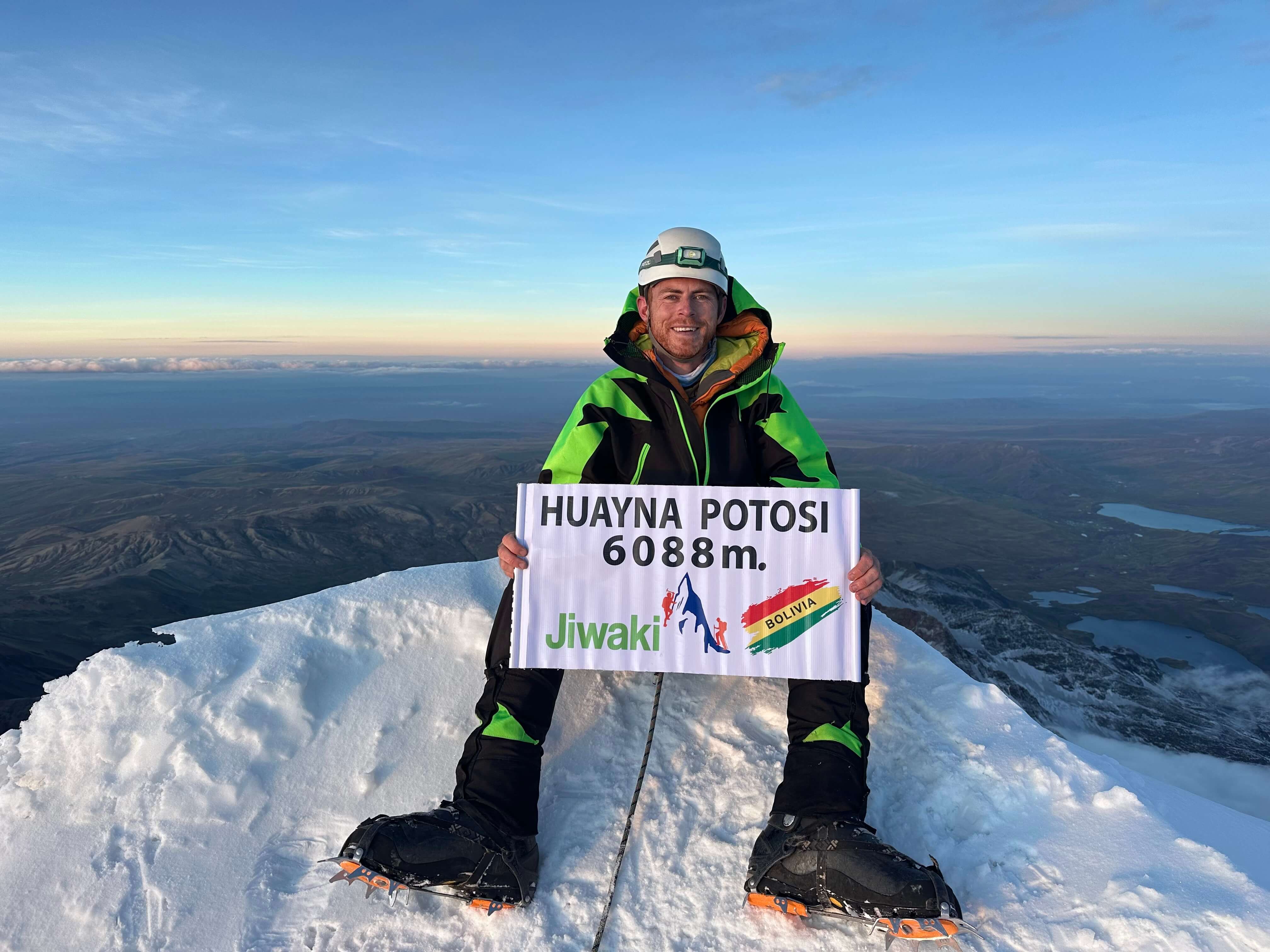
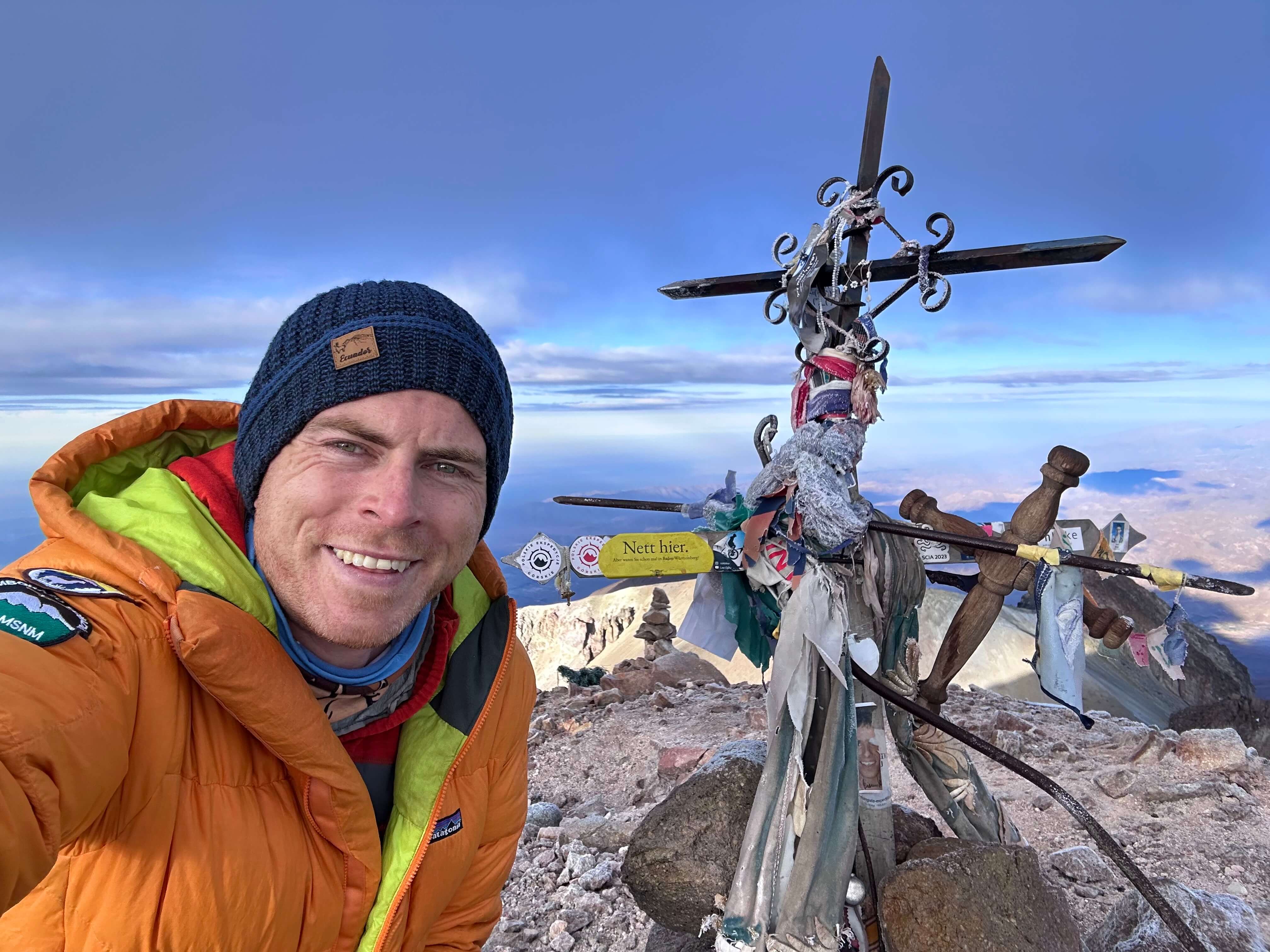
Every two weeks leading up to the climb I summited a 6,000m peak, these were Cotopaxi, Chimborazo, Chachani and Huayna Potosí. On top of those I did more than ten hikes above 5,000m and even swam above that altitude. Combined with lots of running and hiking, I arrived in Mendoza feeling as prepared as I possibly could.
The gear was a nightmare, trying to get my 150L expedition duffel over from Ireland. No courier would ship to Argentina, so I sent it to Santiago in Chile instead. There were customs delays, threats of enormous import fees, and weeks of stress before I eventually got the bag and flew it onwards to Mendoza. I was unbelievably relieved when it finally appeared at the airport.
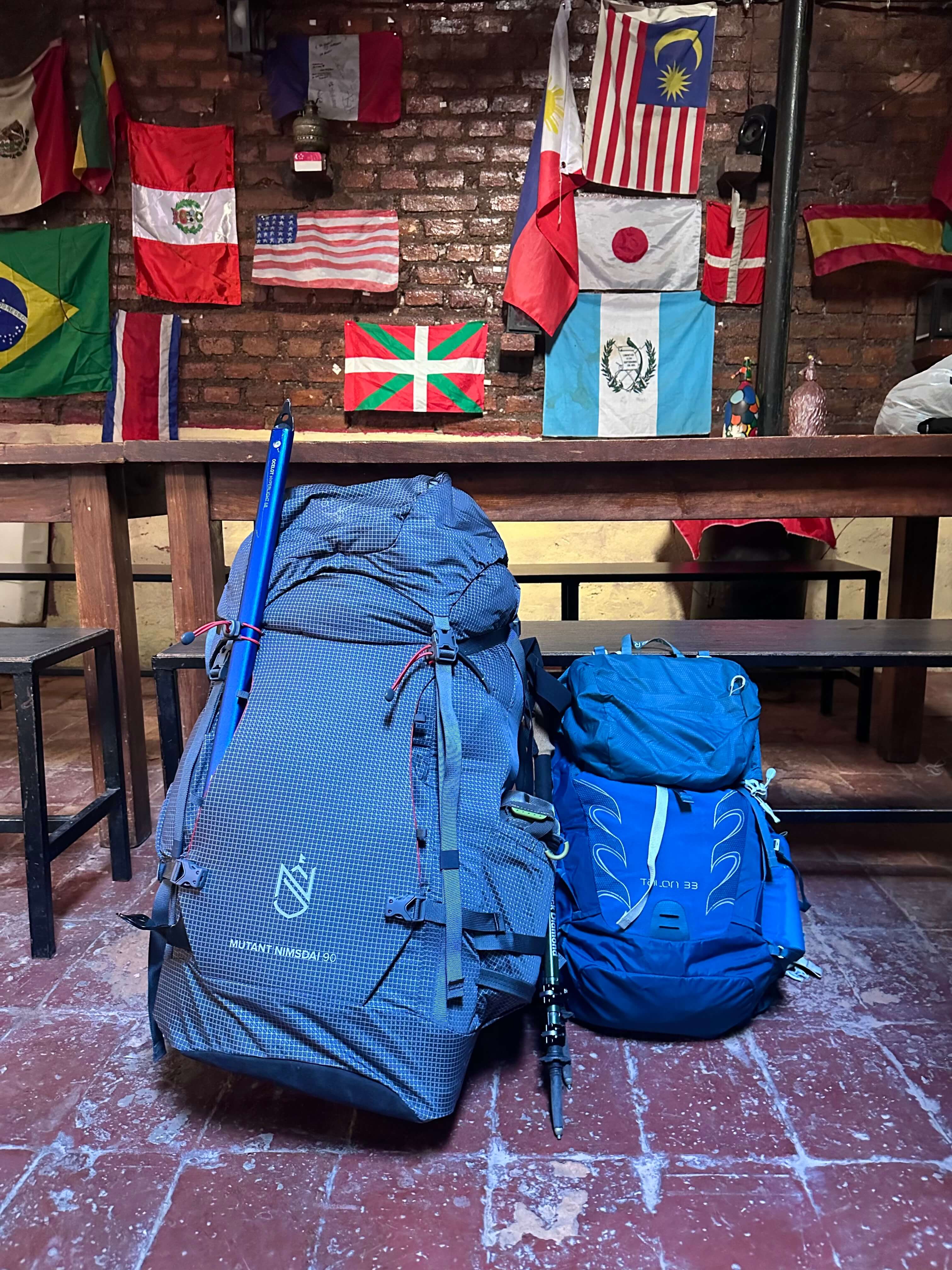
It’s advisable to rent double boots and crampons because they’ll take a battering, but I preferred to have my own to know they’d fit. I use La Sportiva Olympus Mons, with Petzl Vasak crampons and was just careful with them. Then I had my patagonia sun hoodie, heavy Rab down layers, Julbo glasses, a Rab -40°C expedition sleeping bag, and all my usual kit. I packed it into my Osprey Mutant 90, which I love. In my opinion it’s the best large climbing pack on the market. I also had a smaller Osprey Talon 33 for the hike into Plaza de Mulas.
Arrival in Mendoza
I arrived in Mendoza two days before the expedition and stayed in a hostel, eating loads and organising my gear. The city felt surprisingly green considering it’s in a desert. On a walking tour I learned about the irrigation channels that keep the trees and farms alive, the famous wines of the region, and met a man who had just successfully summited with INKA. A good omen hopefully.
When the time came I moved to the official hotel where I met Gonzalo, the assistant guide who I’d be with for the first few days. He checked my gear, confirmed everything looked good, and told me to relax for the evening. There was a nice pool but I didn’t want to risk sunburn before the climb.
The next morning we met our driver Maxi and left Mendoza around 10:30am. We stopped at the INKA office for paperwork and expedition t-shirts before the long drive towards the Chilean border. The road followed the Mendoza River which looked perfect for kayaking.
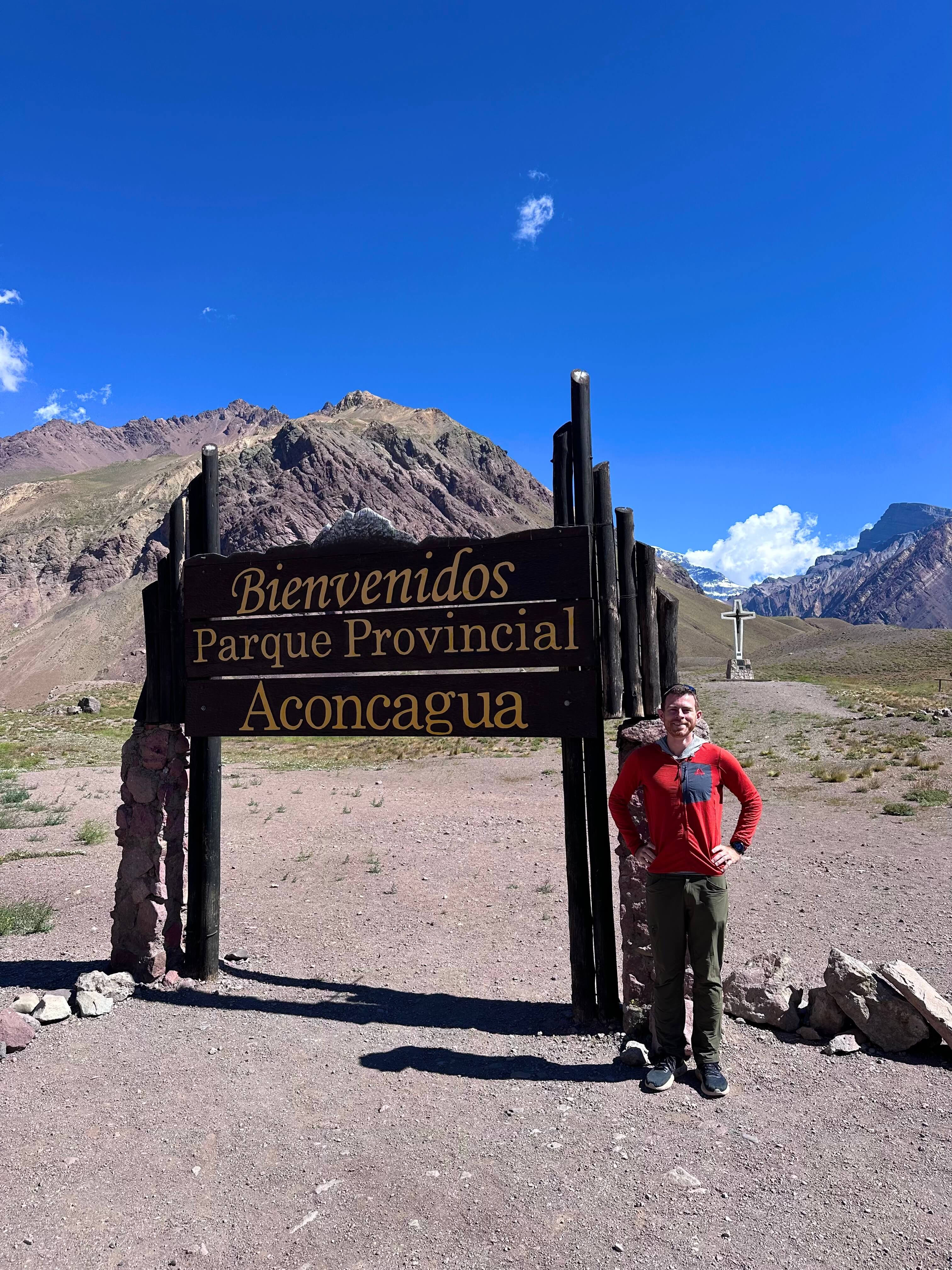
At the entrance to the national park in Horcones (2,950m), we packed and weighed our mule bags, then continued to a refuge to spend the night. Over dinner I met Karol, a Polish guide leading a team of five clients. He had climbed multiple 8,000m peaks and told me stories from Everest.
Day 1
Hike to Confluencia Camp (3,390m)
Today I met Andre and Anton; two Russians who were climbing just Bonete as their first ever hiking trip. It would be the three of us with Gonzalo for now. After packing their mule bags and signing into the national park we began. It was very hot.
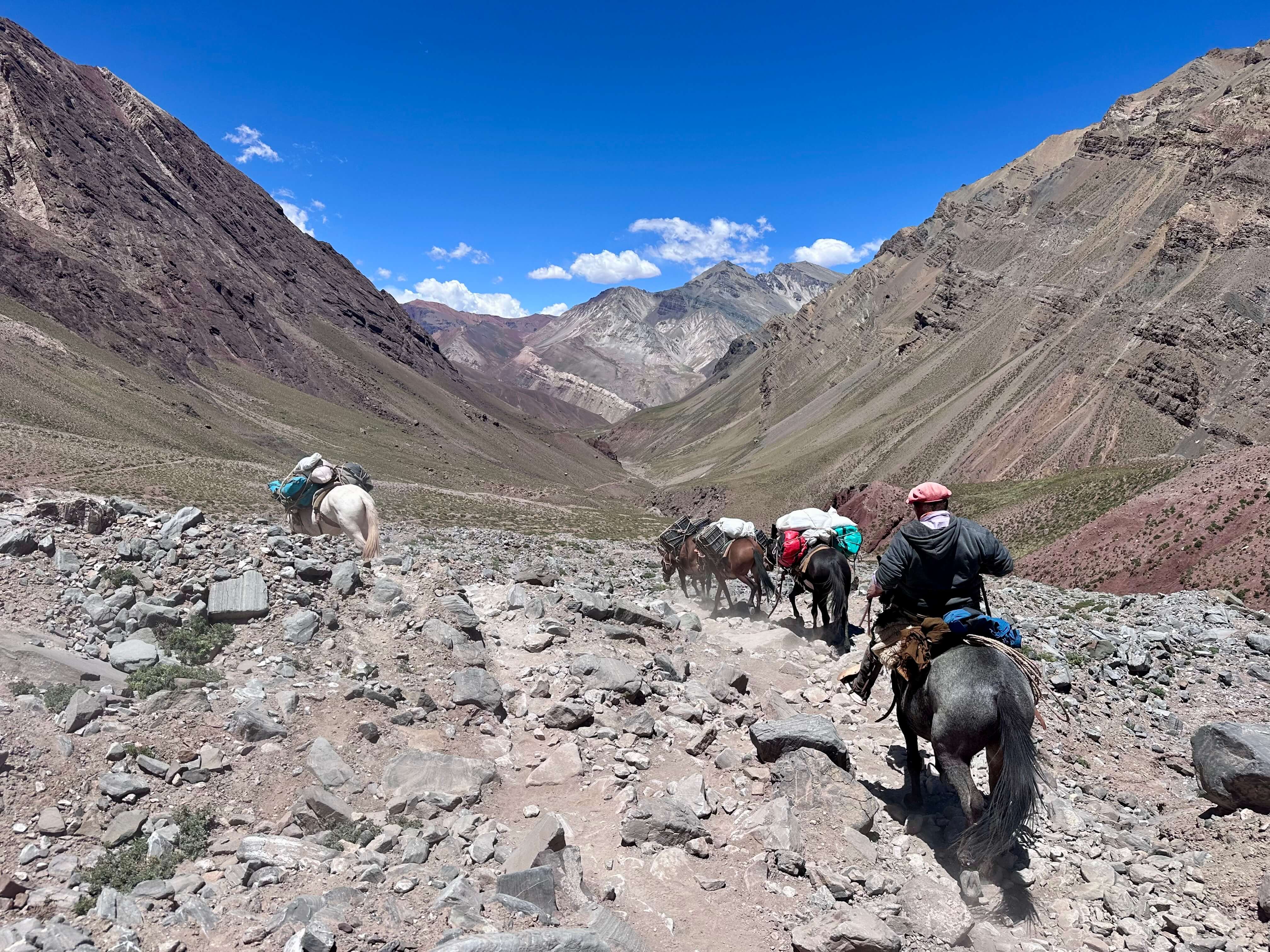
The landscape was harsh and dry. Helicopters flew overhead carrying supplies and evacuations, while long lines of mules flew past at impressive speed. We crossed a bridge that was built for the movie Seven Years in Tibet, and gradually worked our way towards camp. In front of us was the snowy dome of the summit which looked intimidating.
Confluencia Camp (3,400m) was far more comfortable than I expected. Huge dome tents served buffet meals, there were proper bunk beds, and I spent the evening chatting with some Germans descending from their summit attempt. The food throughout the expedition always surprised me with how good it was.
Day 2
Acclimatisation Hike to Plaza Francia (4,200m)
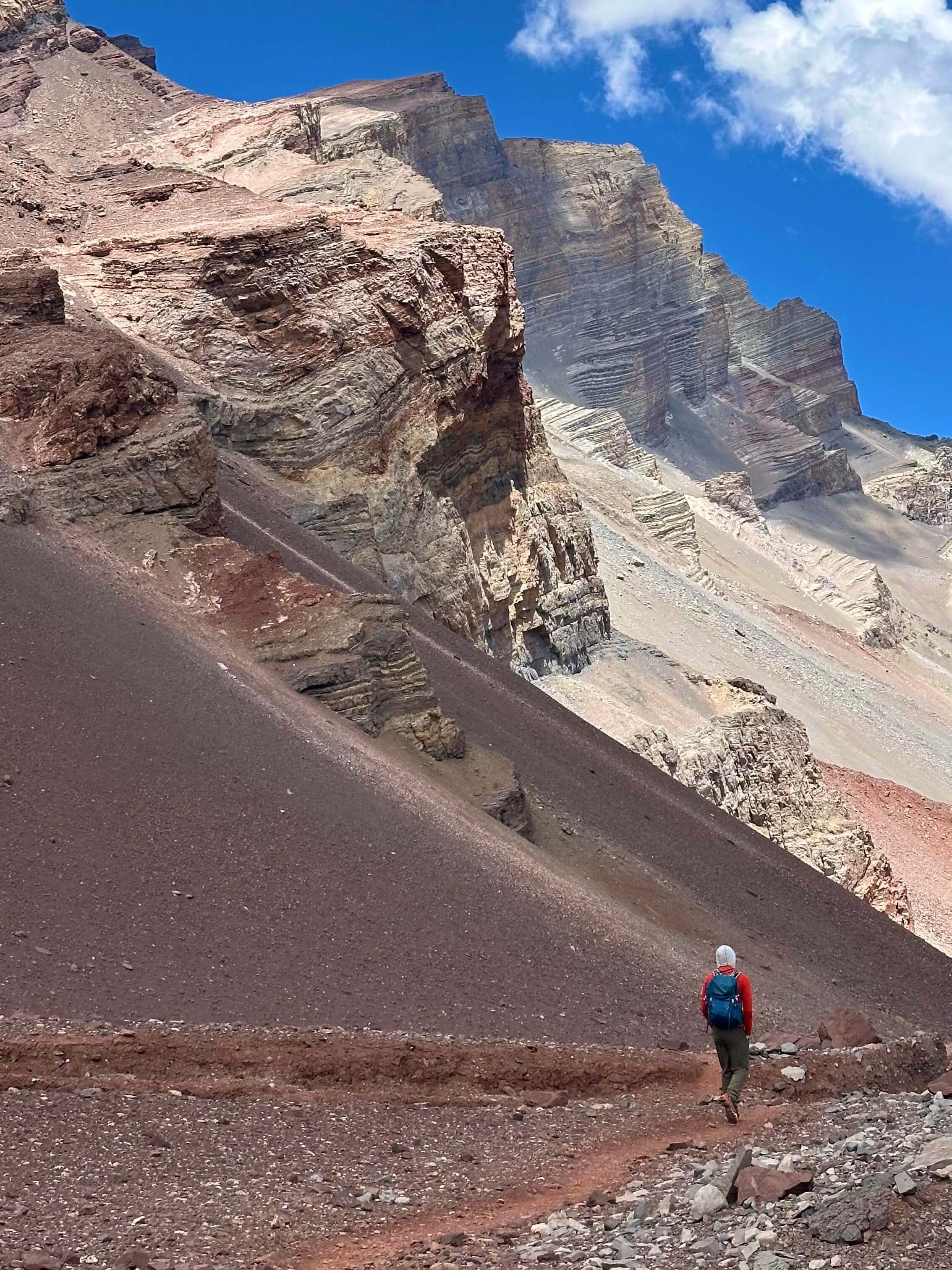
A hot and easy acclimatisation hike beneath the south face of Aconcagua. The trail was mostly flat, but the heat made it feel harder. Andre and Anton struggled even at a slow pace, but I felt comfortable. The ground was dry and cracked, full of cool patterns and colours. At times it revealed giant quartz crystals that were just below the surface.
Clouds rolled over the mountain as we ate lunch below the face, then we slowly returned to camp. There’s already no life up here. No birds, animals, or even grass. It’s quiet and still. The evening brought a beautiful sunset and more great food. I also met Anar, a Kazakh climber on a private INKA trip who I would bump into again on Denali months later.
Day 3
Confluencia (3,390m) to Plaza de Mulas (4,370m)
The hottest day of the whole trip. 18km of dust, bridges, river crossings, mule trains and dry valleys. Whenever we passed a small cliff you’d see climbers huddled in whatever shadow they could find. My 3L of water ran out on the steeper second half of the day, so when we saw camp I was allowed to walk ahead. I got there 30 mins early and needed that time and water in the shade.
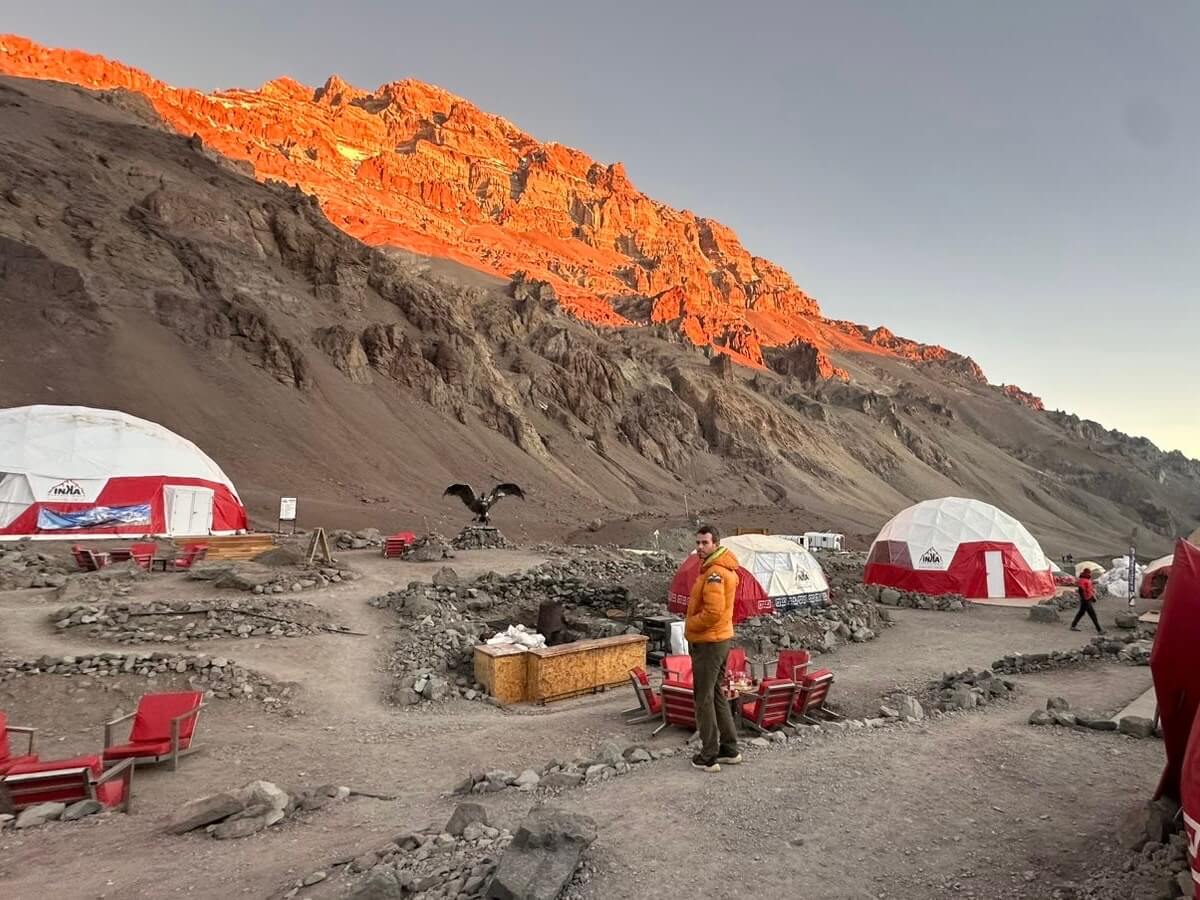
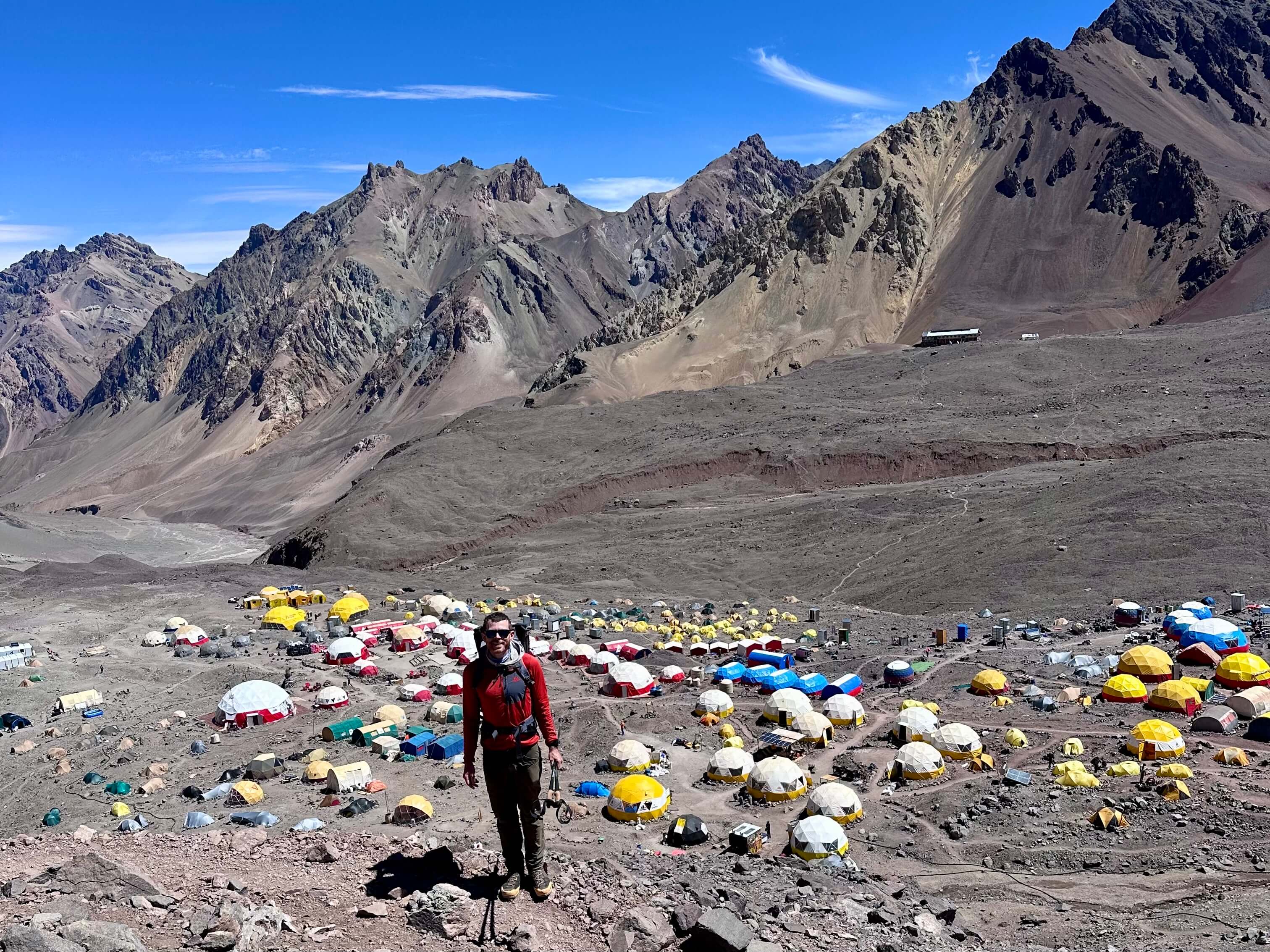
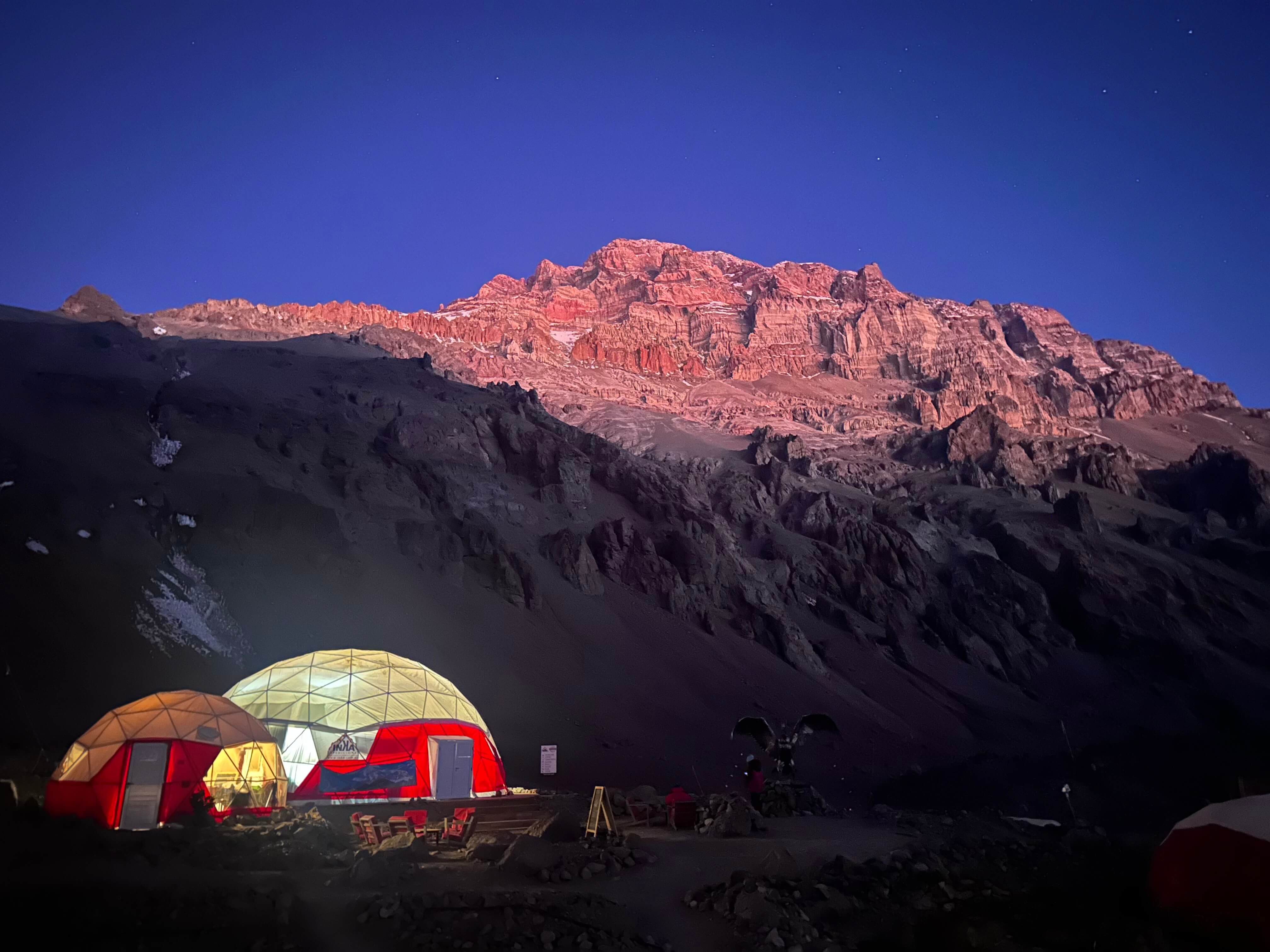
Plaza de Mulas is an enormous tent city in the middle of nowhere. It’s on a glacier, but there’s so much rock on the surface that you often forget that. My bag arrived safely with the mules and I got a tent to myself. It was cold once the sun disappeared, which was nice. I loved how the dome tents glowed in the night, and stared up at the perfect stars above the peak.
Day 4
Rest Day at Plaza de Mulas (4,370m)
After a buffet breakfast (base camp is great), we did a short hike to a frozen lake surrounded by penitentes. The strong wind made it tough to video, but it was very cool. I could feel my appetite fading, but forced myself to eat. Most people lose weight on Aconcagua, but I was determined not to. You need that energy.
Plaza de Mulas feels like a small mountain village. The main INKA dome tent had books, games, a café and WiFi. Charging phones was free but charging anything else cost $10. Luckily no one ever noticed it was my powerbank charging inside my phone case. There’s outdoor seating, a foosball table, and a giant condor statue where I would watch the sunset over the peak each night.
Day 5
Cerro Bonete (5,052m)
Our first climb. Bonete is near the camp, with a great view of Aconcagua, but still a long ascent. We left after breakfast with packed lunches from the buffet tent, moving upwards through rocks and penitentes. There was scree and several river crossings, including a bridge made from an old wooden door.
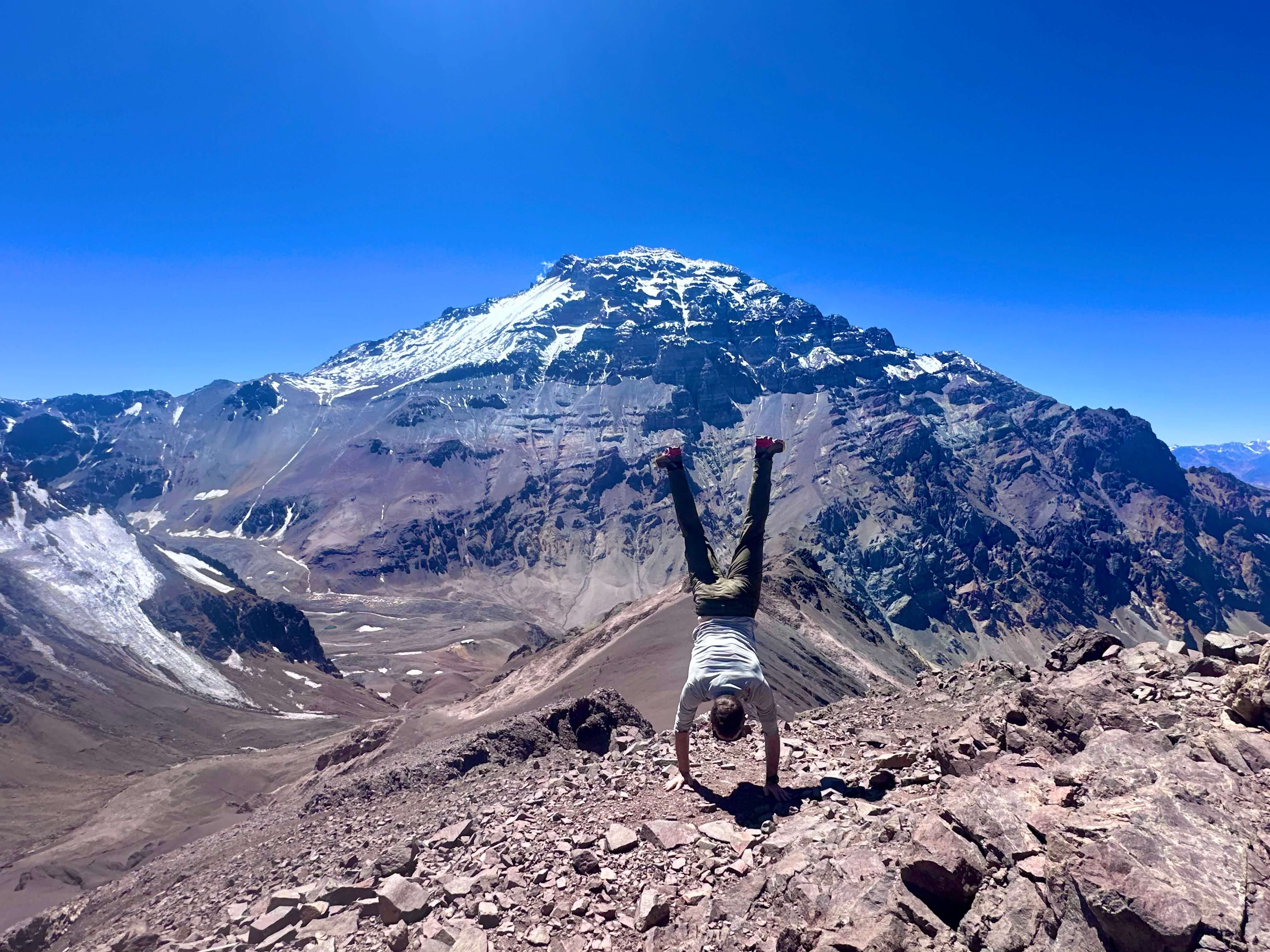
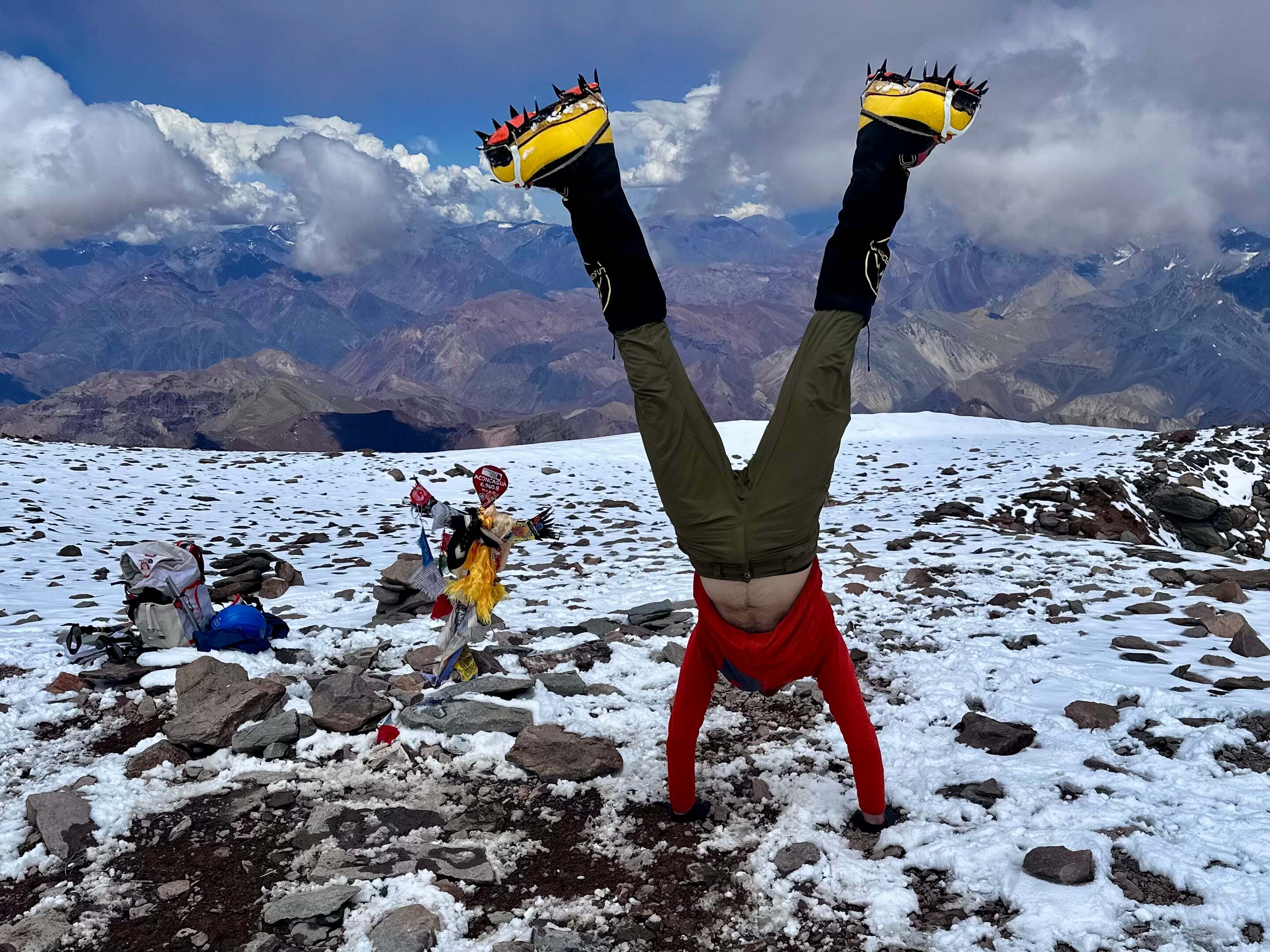
We passed an abandoned mountain hotel before climbing steep zig-zags towards the summit ridge. Helmets went on for the final scramble and the views from the top were unreal. I got my usual handstand photo and we ate lunch on top, before skiing down the volcanic sand on the descent.
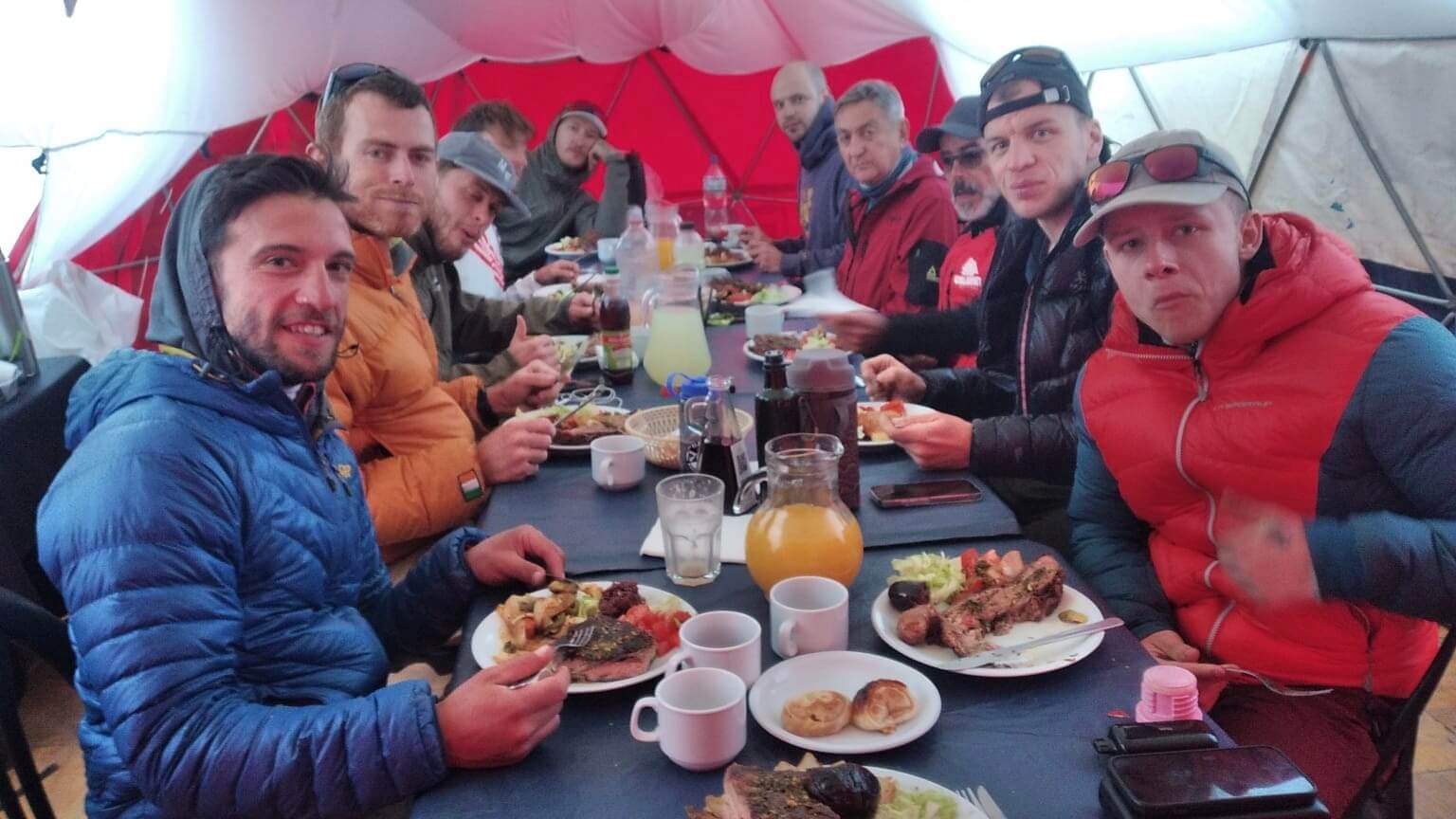
Back at camp, the rest of the group had arrived. The lead guide Marcelo was calm and easy going, but it didn’t hide his obvious experience. The team consisted of two Belgians named Alex and Francois, John from the USA, Attila from Hungary, and two Argentinians; Augustine and Francesco (who was Marcelo’s father). One member had already left after twisting an ankle lower down the mountain, leaving seven of us in total.
There was a mixed level of experience, ranging as high as Kilimanjaro in some cases, and with no shortage of confidence. I felt some were getting ahead of themselves with future plans and underestimating the climb we were on. Everyone had come directly from sea level and a few had headaches already. Nonetheless we had fun getting to know each other and my hopes were high we’d all be celebrating on the summit in a weeks time.
Day 6
Rest Day
This was the end of Andre & Anton’s trip so they descended with a different group. The rest of us had a relaxed day of eating, packing and chatting. We packed 6kg of food each for the higher camps and also 5L of water each because Camp 1 had no reliable source after the heat. Marcelo went over our plan for the coming days and how that fit with the weather forecast.
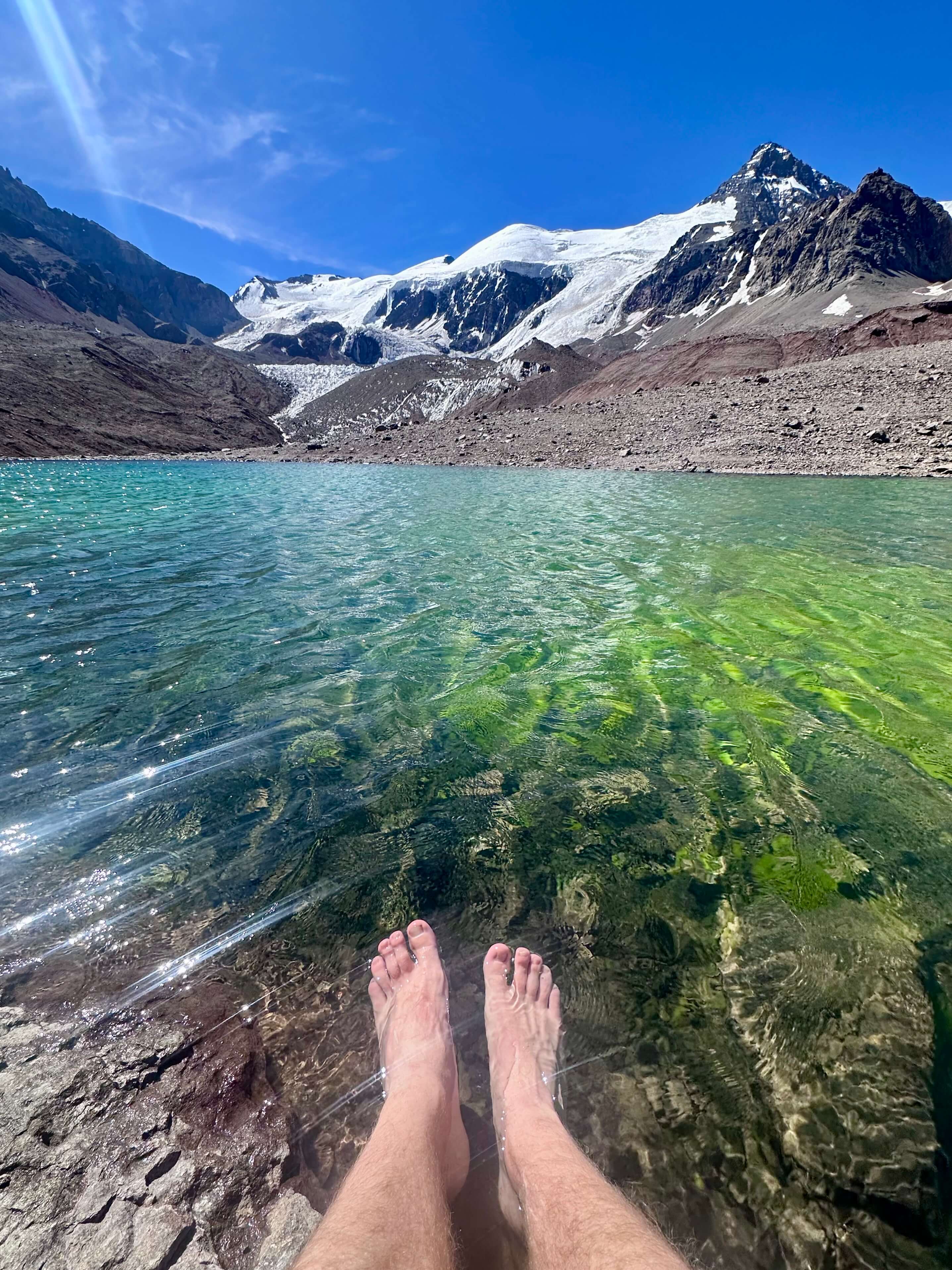
That evening we walked to a turquoise lake for a swim where Francois cut his foot on some rocks. Dinner was a huge barbecue and I spent hours talking with Alex about his goal of climbing the highest point in every country. This was roughly number 10 of the 197 for him, and it was his first test of high altitude. It’s a particularly ambitious goal.
Tonight we had an amazing asado (Argentinian BBQ). Most people drink wine with dinner, but I mostly avoided it and focused on hydration instead. I was consistently drinking my 5L a day, mostly with electrolytes. In the evening we explored the wider camp which has the world’s highest art gallery, but it wasn’t too late of a night.
Day 7
Carry to Camp 1: Plaza Canadá (5,050m)
Today we carried gear to Camp 1 and returned to base camp. The pace was slow and comfortable, taking around three hours. The white winds painted themselves over the summit in wavy patterns, but we were sheltered down here. We passed more penitentes and had impressive views back down to Plaza de Mulas. After struggling to find the key for the storage tent, we cached our equipment and descended again.
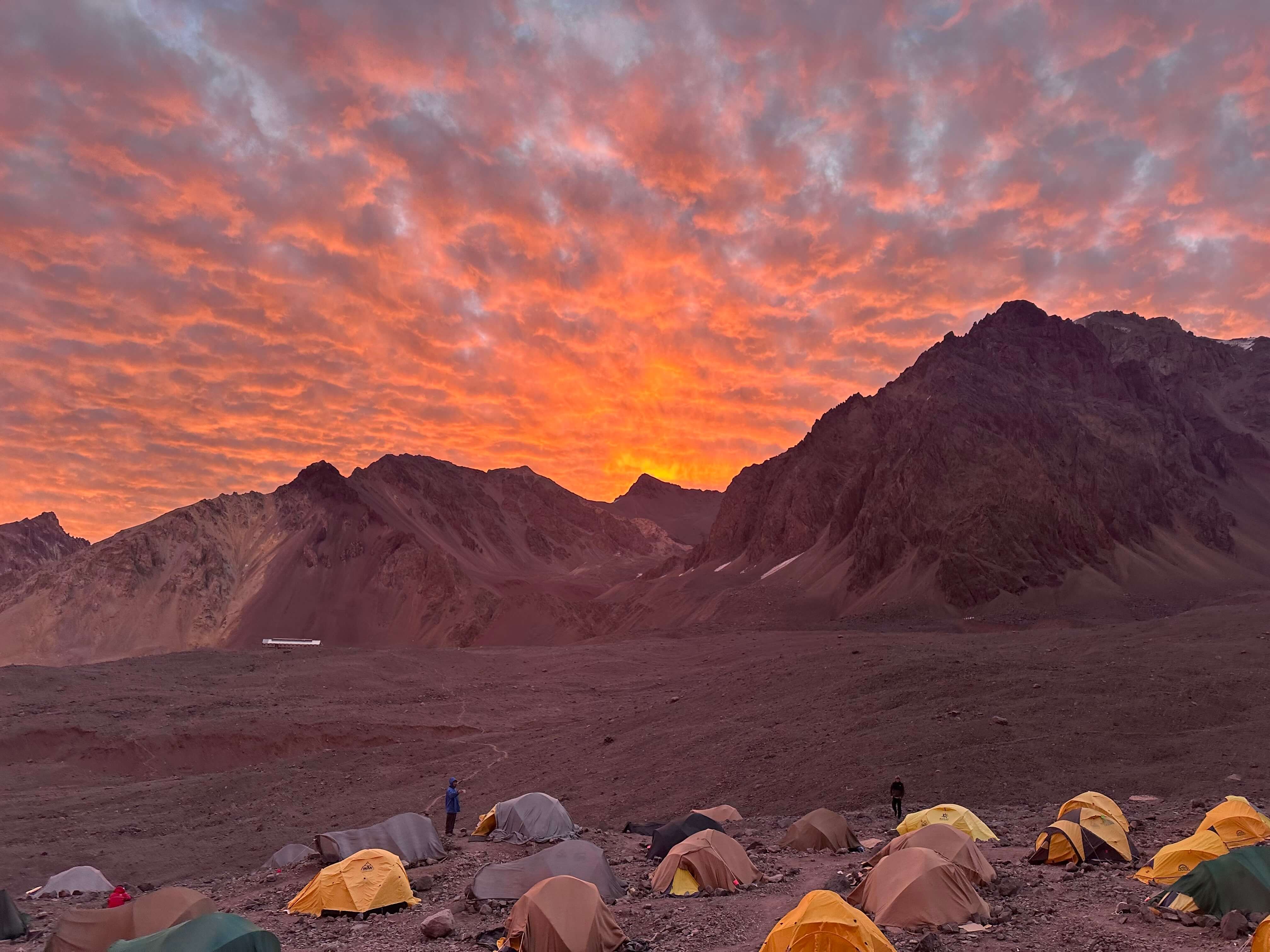
John and I skiied down the scree while the others struggled with the soft terrain. It helps to get down and out of the sun quicker where you can. That evening John received news of a family emergency back home and had to arrange a helicopter evacuation. We stayed up chatting and drinking wine with him late into the night before saying goodbye. Sunset behind the condor statue was particularly dramatic this night too.
Day 8
Rest Day
John flew out that morning, and the rest of the day was quiet. Journalling, playing chess with Attila, discussing how his life working in China for years, calling home from the dome tent, and another asado for dinner. Today we also had our mandatory medical checks. The base camp doctors listened for fluid in our lungs and checked blood oxygen levels before signing our permits to allow us higher. Skipping this step before a summit push results in fines and a lifetime ban from the park.
We were relieved to all get the nod of approval from the doctors. Later that evening, the wind became terrifying. We had known the forecast, but it was rough. Tents whipped violently around camp and the toilet became a wind tunnel. The white clouds spilled over every ridge in strange formations that looked fake. Showers up here cost $10 but we had one free token included. I used mine that night and felt amazing after, then ran to my tent to wait out the storm.
Day 9
Move to Camp 1: Plaza Canadá (5,050m)
The morning was delayed while people assessed damage from the storm. Some tents at Camp 1 had blown away, but thankfully ours survived. We left at 1pm after a breakfast of bacon and quesadillas. The climb was straightforward and familiar. At camp, Attila and I claimed the flattest tent spot. We would share from here on.
That evening was unusually calm. We ate dinner outside looking down towards base camp far below. Everyone debated whether to wear their summit boots from here, or carry them higher. I decided to wear mine and save some weight. If you walk carefully the rocks don’t always shred boots.
Day 10
Move to Camp 2: Nido de Cóndores (5,550m)
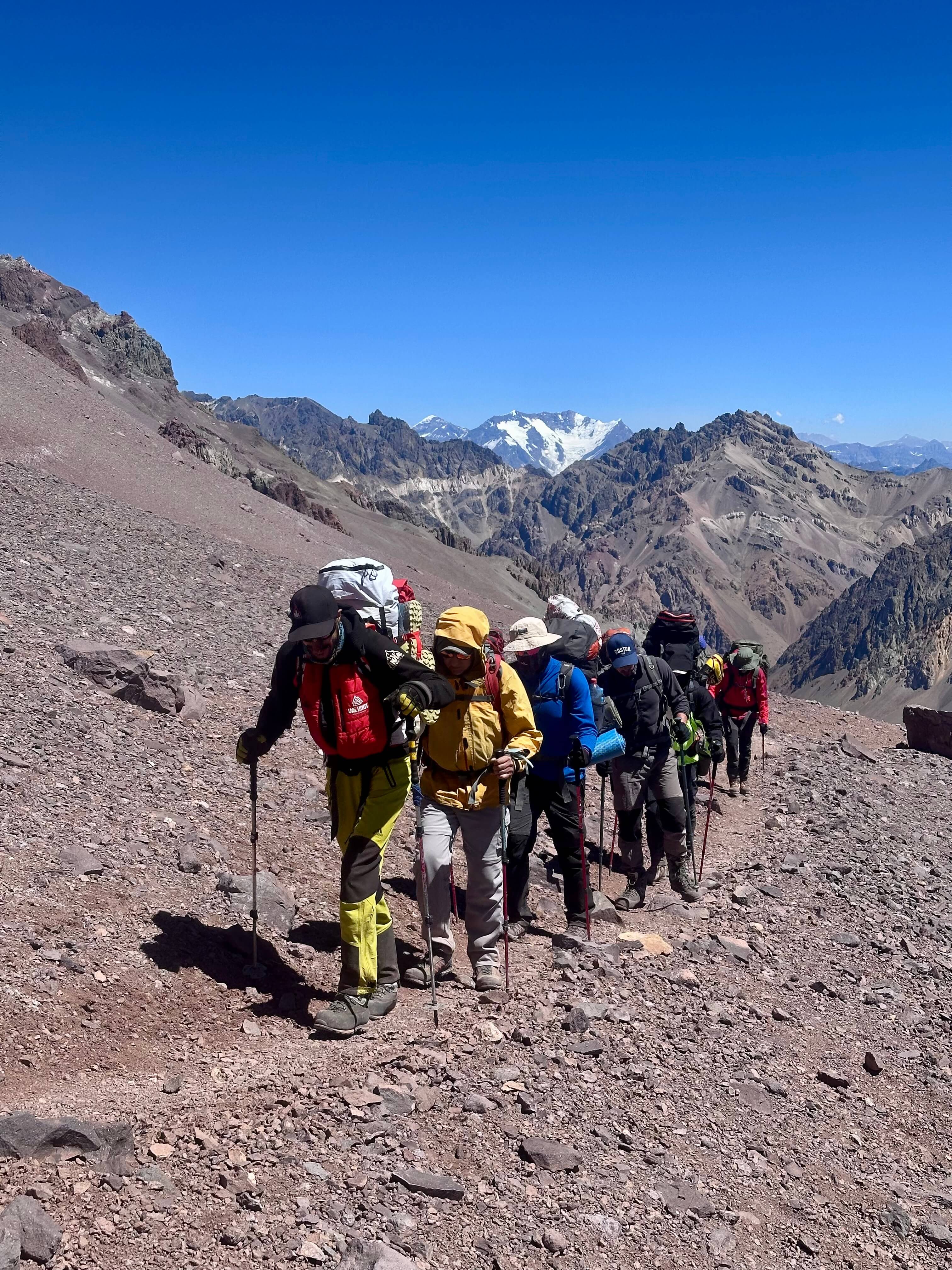
Heavy bags and a slow pace. Everyone else’s packs seemed enormous, with gear hanging off 100L+ bags. I was happy with how efficiently I’d packed, and how the Mutant 90 sat so comfortably even fully loaded. Others had a very hard time today.
Nido de Cóndores had a cool atmosphere. As I set up our tent, and held it down with rocks, I considered how I would never want to bring my own tent to this mountain. It’s so rough on gear. We met lots of solo climbers who were sick from drinking untreated lake water from this camp. Thankfully we were more careful with filtering and boiling everything. The sunset that night was incredible. We sat above a sea of clouds watching the light fade over the Andes.
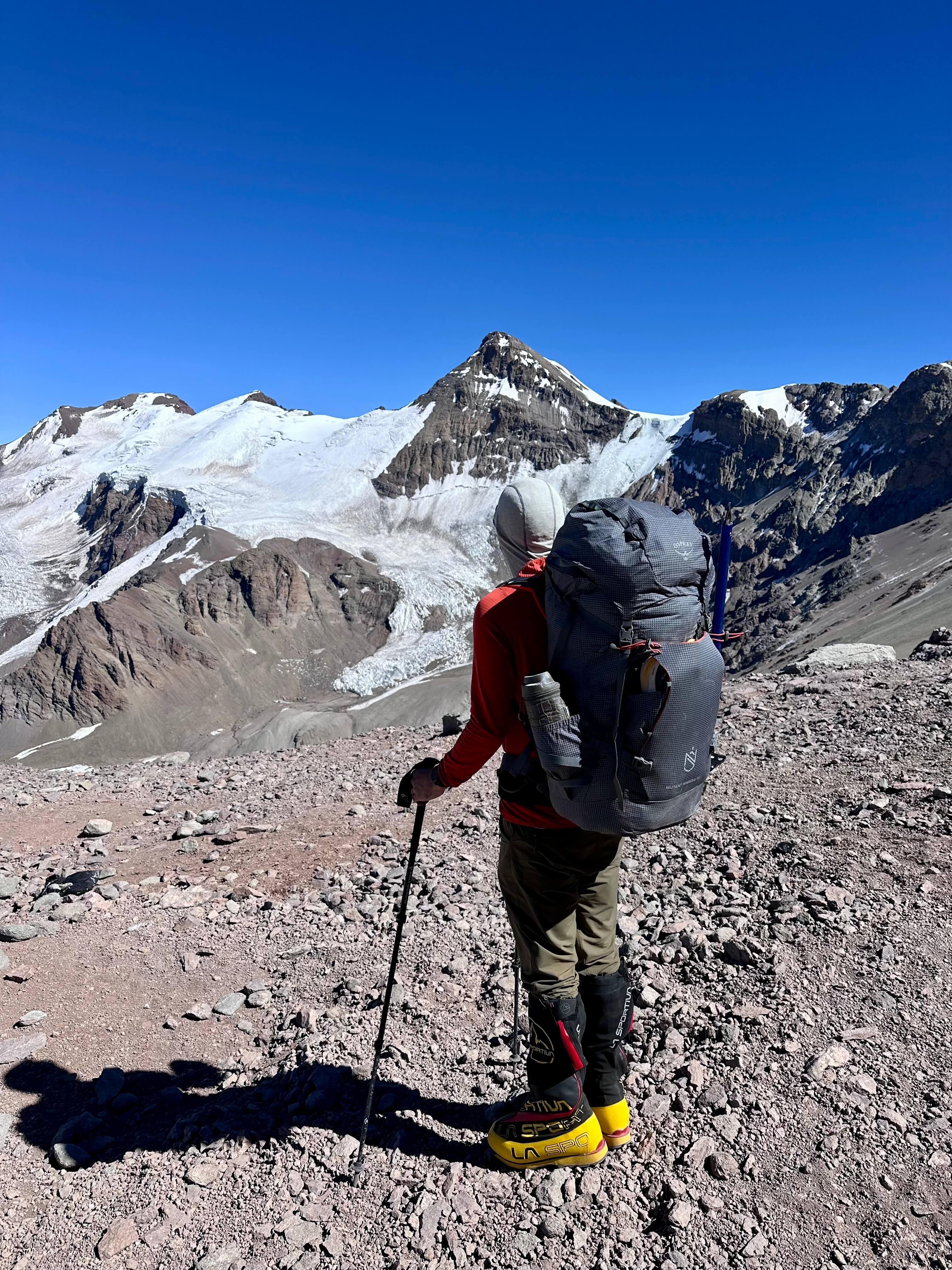
Day 11
Rest Day & Snow Skills
That had been the highest I’d ever camped, and luckily I slept fine. I met Karol in the morning who confirmed that the forecast for our summit window looked “miraculously clear”, which everyone in camp seemed excited about. There was a slight fear of queues on the traverse as everyone targeted the same summit day, but we were just happy there would be low winds.
That afternoon we practiced snow skills on a slope near our camp. The group struggled with crampons and movement so I spent time helping out, before being allowed to just take photos as they had to focus a lot on the basics. That night the kitchen staff somehow made pizzas. At 5,550m!
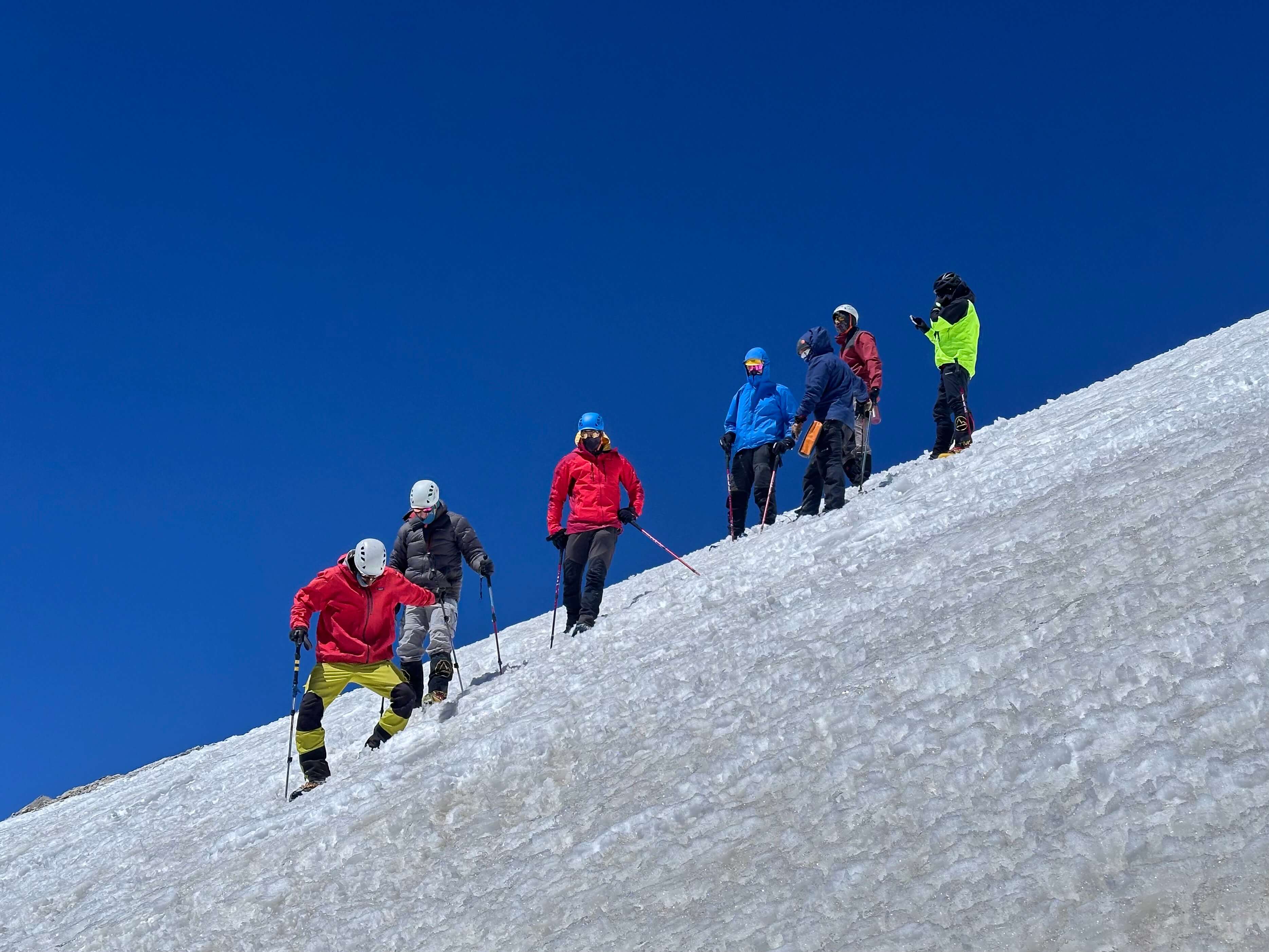
Day 12
Move to Camp 3: Cólera (5,970m)
Another move day, another heavy pack. We climbed yesterday’s snowy slopes, then zig-zagged up to Berlin Camp which is nestled in rocks. We got photos at a scenic cross, then scrambled up to our final high camp beneath the summit slopes in Camp Cólera (5,970m). Higher than Kilimanjaro. The air is thin, and even more so when breathing through a neck scarf to avoid a cough from dry air, but I felt good.
A snowstorm hit that evening bringing freezing temperatures and strong winds. I spent the day aggressively hydrating from early on, eventually drinking 7.5L by dinnertime. I finished it early to avoid bathroom breaks waking me in the night. Most people had headaches and nausea, but I had no symptoms yet. I packed everything for the summit nice and early too, and after a final hot chocolate it was time for bed.
At altitude, small frustrations feel enormous. Attila was very disorganised and his packing began when everyone else went to sleep. This meant 1.5 hours of his headtorch flashing, him talking through his packing, and gear being landed on me. I only managed a few hours sleep before alarms went off at 3:00am. In the moment this was stressful.
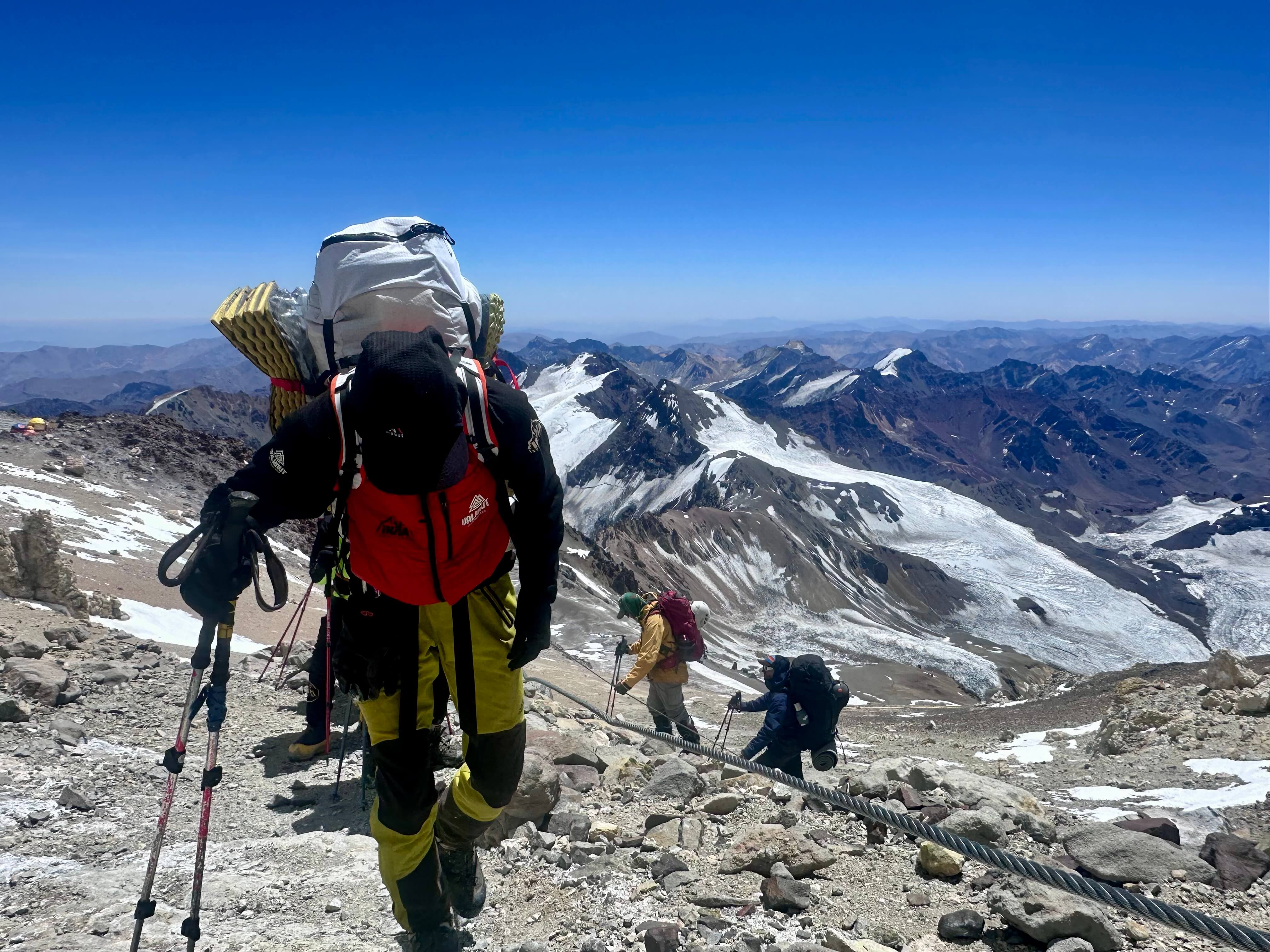
Day 13
Summit Day (6,961m)
We woke to complete darkness. Tea, breakfast and final layers went on before we stepped into the freezing cold around 4:30am. The early climb moved slowly through firm snow until sunrise lit up the mountains behind us. Augustine turned around from exhaustion at our first long stop, and Francesco turned at the second, leaving four clients and two guides continuing towards the traverse.
It was clear and calm all morning. We put on crampons beneath a steep snowy slope and carefully climbed onto the traverse itself. Two days earlier someone had died there, which weighed on everyone. The route was beautiful, but serious. The sun had lit the traverse fully by now, which is what we based our start time on. It’s safer with daylight.
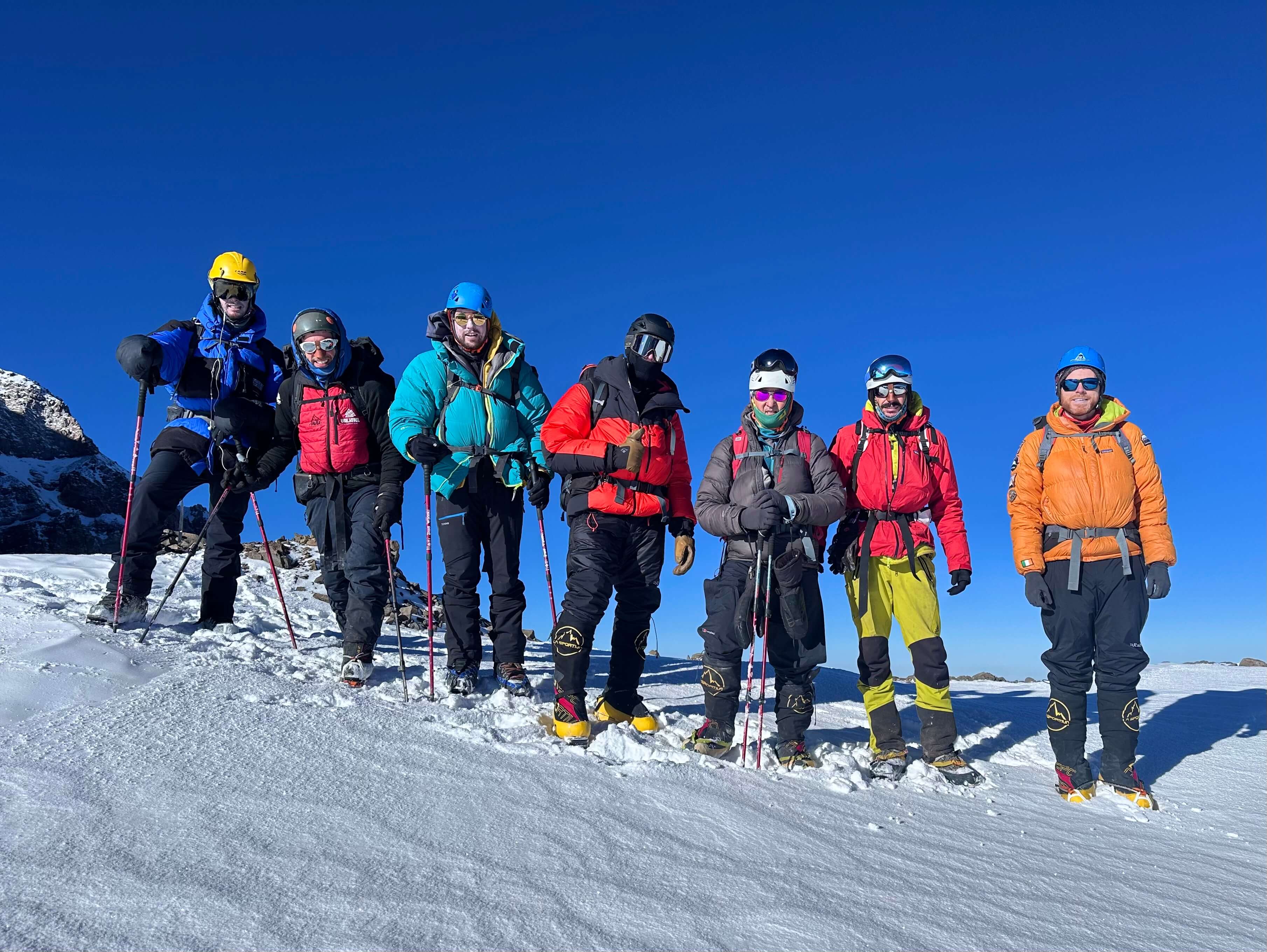
As we crossed, Attila began deteriorating badly from altitude sickness. Marcelo realised that the Belgians were fading too, exhausted and struggling to walk. Rather than immediately sending Gonzalo down with Attila, Marcelo pushed us onward to La Cueva so the situation could be properly assessed there. Otherwise he knew no one would summit if he had to bring the Belgians down after.
It took us an hour longer than expected to reach the cave. I waited 20 mins there before the others arrived, and when they did it was obvious things had changed. Attila needed a dexamethasone injection to help his symptoms. Alex and Francois were barely functioning. Marcelo explained that this would be their summit and Gonzalo prepared ropes to take the three of them down. Alex argued, but it was the only safe decision. More dexamethasone and oxygen were needed to get the three down.
From here it was just Marcelo and I. We left a lot of our gear in the cave and began climbing the Canaleta. The final 2.5 hours were the most difficult thing I’ve ever done. I had heard this section was the hard part, but feeling perfect at the cave I wondered how bad it could be. Hypoxia at those altitudes is difficult to describe, but it felt like exercising with one lung.
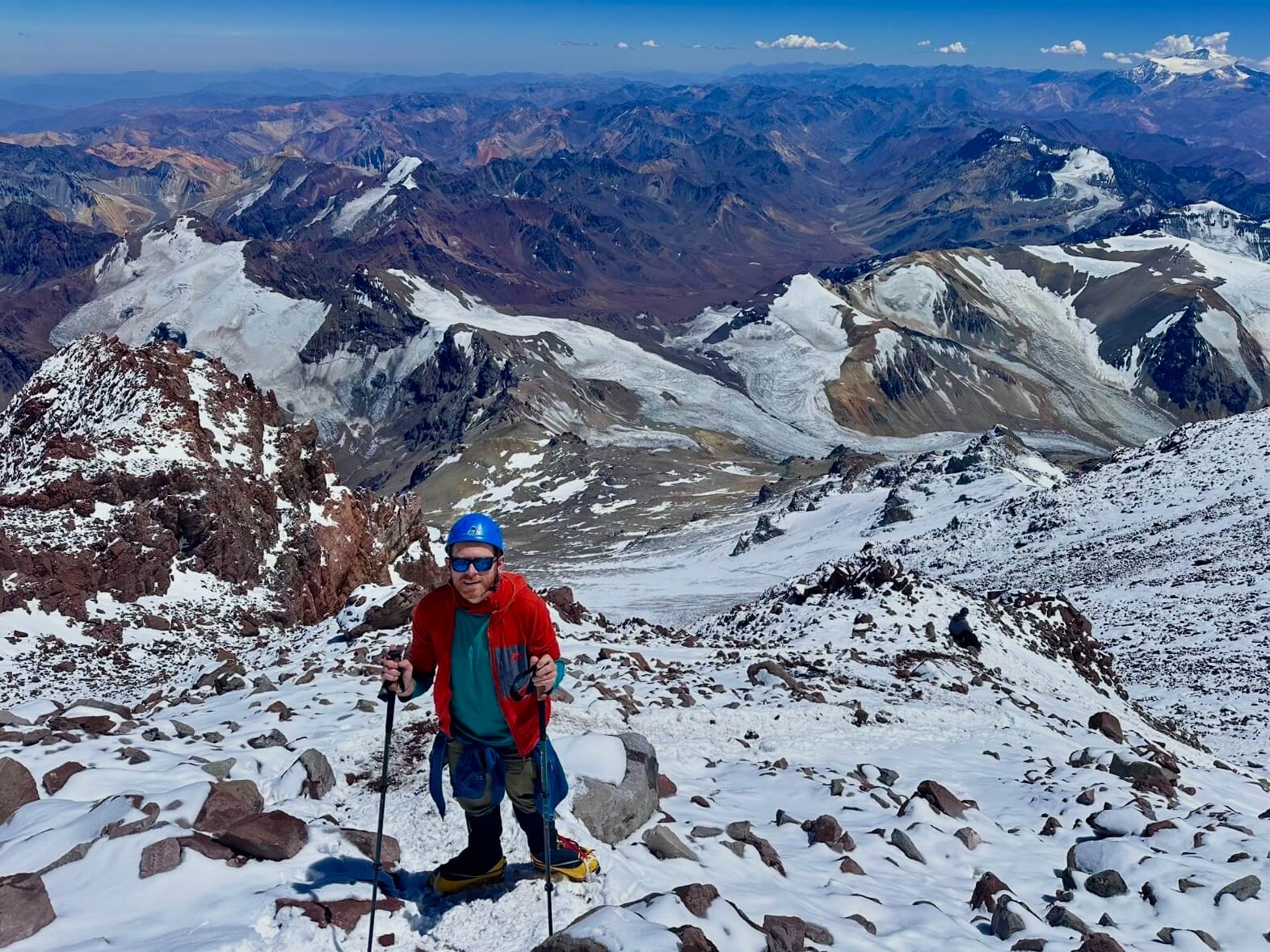
We moved faster than others around us, but still incredibly slow. I found a rhythm that worked; two deep pressure breaths per step, plus short breaks for water and jellies. Higher up I developed the nausea and mild headache of AMS, but always felt in control which is generally how you know it’s not yet HACE. In the last 30 minutes I had some tunnel vision. Deep breathing and focus kept the blurriness mostly at bay. We didn’t talk much, but Marcelo confided in me that it’s tough for the guides too.
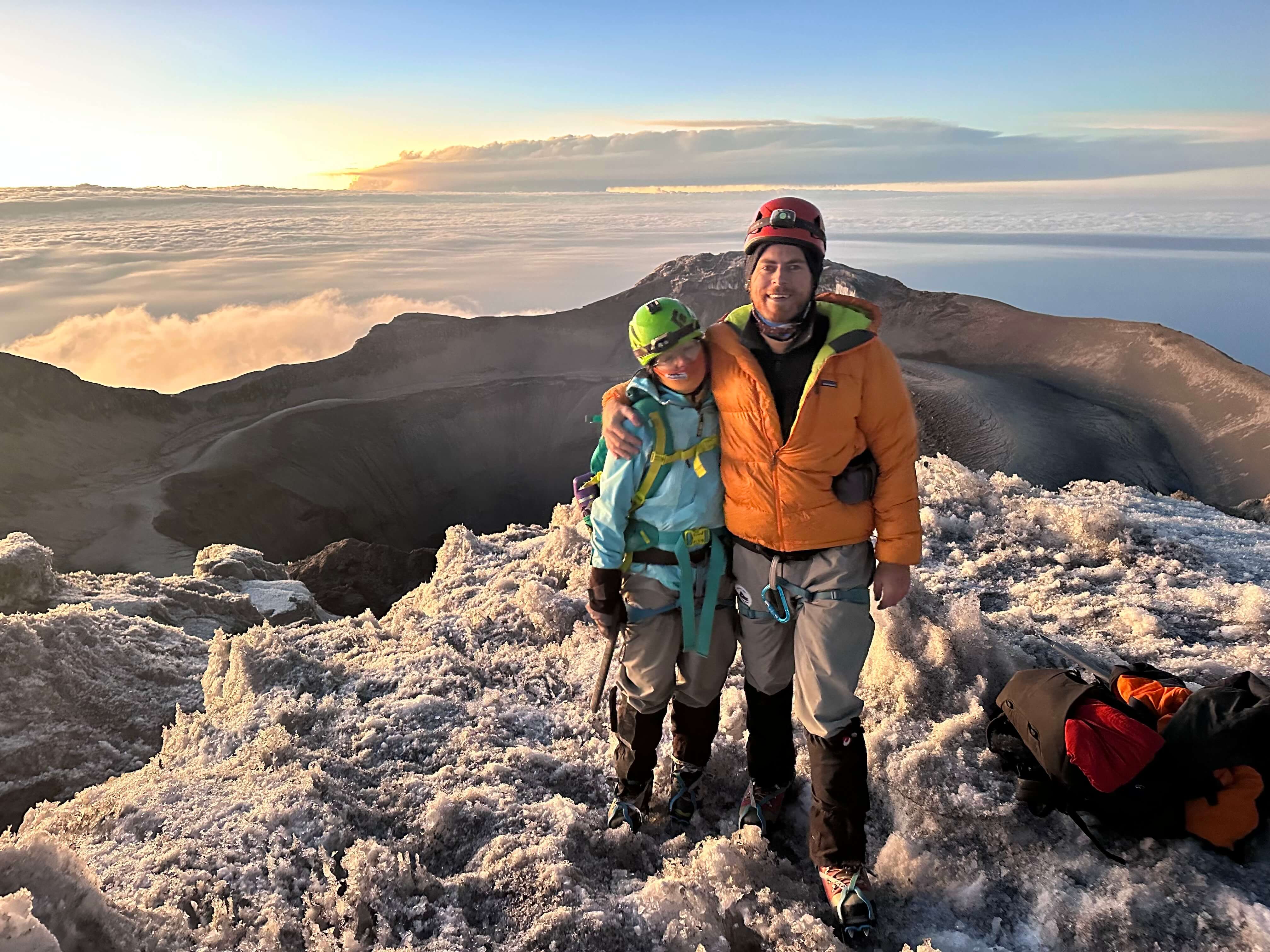
Eventually Marcelo asked for my phone and started videoing me. I scrambled up a rocky corner that I hadn’t realised was the final one, and suddenly saw the condor shaped summit cross. Some clouds had rolled in but I couldn’t care less. Months of stress disappeared instantly. We hugged, took photos, and spent around thirty minutes up there with other climbers we’d met throughout the expedition. I had only a mild headache now and no other symptoms.
We descended fast, grabbing our gear from La Cueva before flying down the traverse. I briefly slowed to walk with Karol, who was helping rope one of his exhausted clients down, despite successfully getting all five to the summit. From the top back to camp took us only 1 hour 45 minutes because we ended up racing an incoming storm.
Back at camp the mood was sombre. The Belgians were understandably upset about turning around, so I was quiet in my overwhelming relief. I had spent months obsessively preparing because I knew success rates were so low. Other teams we’d met had only managed two summits from eight climbers, or three from thirteen. The pressure of knowing how much could go wrong had finally lifted.
That evening I developed dizzy spells and the tunnel vision came back, I managed it with water and deep breathing but was ready to get back down properly.
Day 14
Descend to Plaza de Mulas (4,370m)
I descended quickly the next morning because the intense sun seemed to make the brain fog and dizziness worse. I waited for the others at Camp 2, then again at Camp 1 where we collected cached equipment, and I finally swapped out of my massive summit boots.
Once back at Plaza de Mulas I sat in the shade drinking water for nearly an hour before everyone else arrived. At times I felt drunk; I had a groggy tunnel vision and poor reflexes that came and went unpredictably. That night we celebrated with beers, wine and the greatest gift the guides could give us: free shower tokens!
Day 15
Descend to Horcones (2,950m)
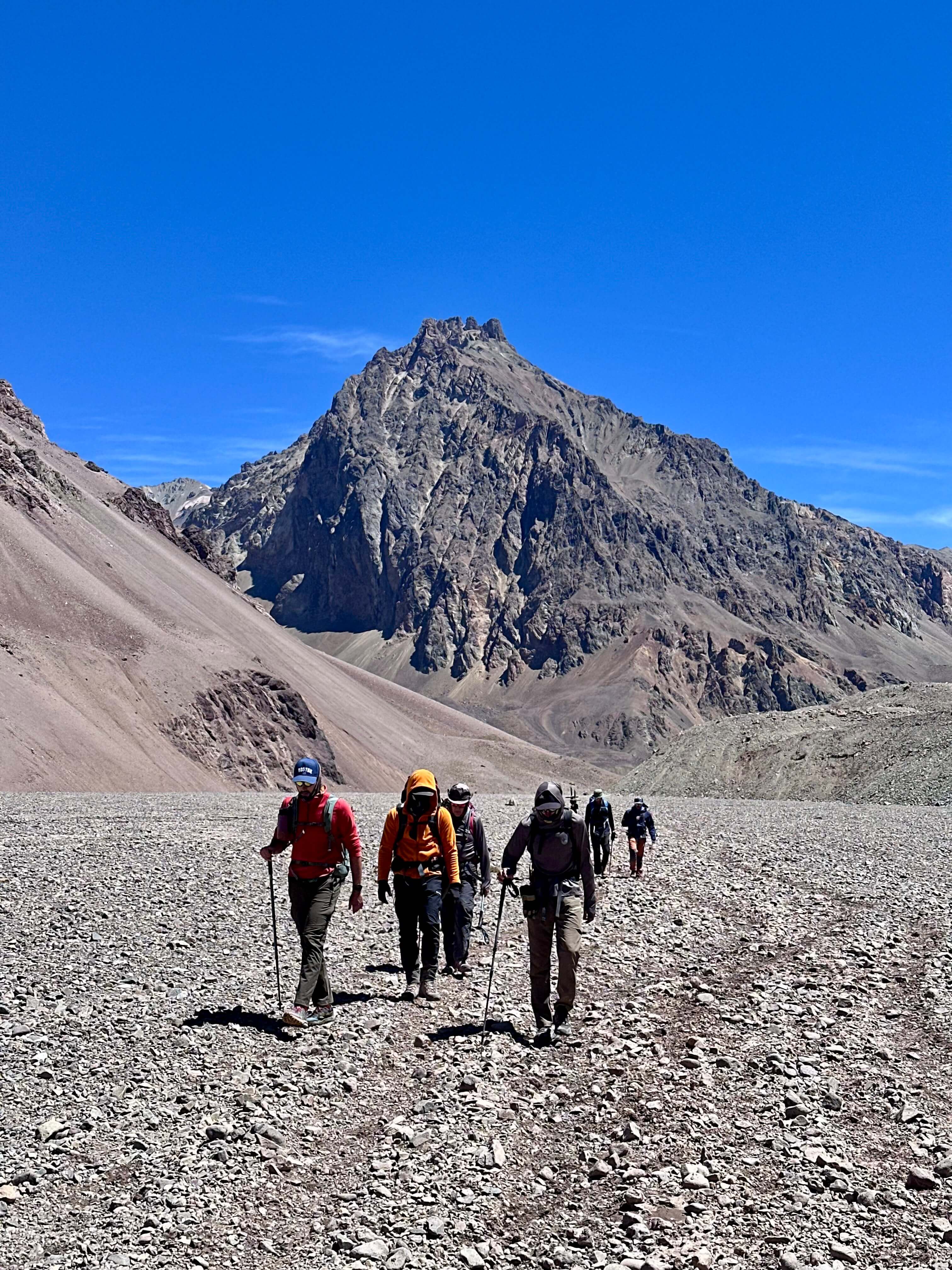
A 26km hike back through the valley. Everyone was ready to leave the mountain by now and the slow pace made the day feel endless.
The return of birds, shrubs and running water felt strangely comforting after so long in the barren upper mountain. We stopped for food at Confluencia, had a celebratory beer at the mule station, then drove all the way back to Mendoza where we finally checked into the hotel around 10pm.
After a proper shower I discovered the extent of the sunburn on my neck. The exhaustion hit me all at once and that hotel bed felt better than any summit. The experience had taken all I had, physically and mentally. Now it was time to rest.
Back to Reality
Recovery was a lot slower than I expected. The brain fog and dizzy spells lasted eight days which genuinely scared me. I had very little energy, and I’d be hit with random waves of nausea and tiredness, during which I could barely stand. I spent the next few days in Mendoza, eating as much good food as I could, doing a wine tour, and trying to rest.
There was unfortunate drama when the two Belgians posted on Instagram that they turned around so they could rescue Attila. They made up long stories where they were the heroes, leaving out the guides who got them down, and all the tears that came with that decision. It left an awful tension in the group and resulted in us not all meeting up in Mendoza, but I did get lunch with Attila who was doing well.
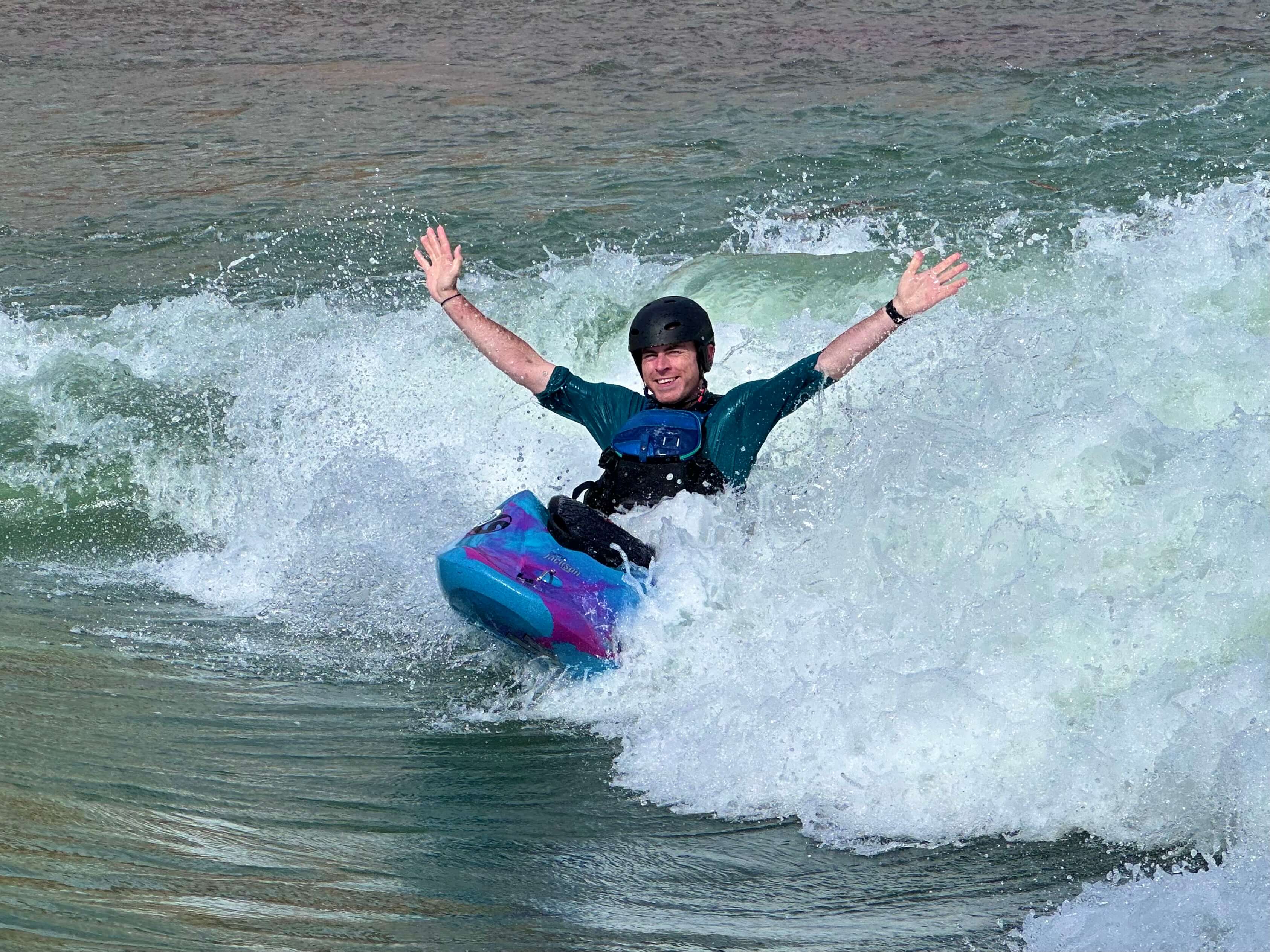
A few days later I travelled to San Juan to stay with my friend Aisling. She was living there to kayak full time on a famous freestyle wave. Luckily she was moving to Vancouver soon, so she brought my giant duffel with her, perfectly placed that I’d collect it en route to Denali in May, and saving me another courier nightmare. Over the next week we fit in some kayaking, running, movies, Fontaines DC, ice cream, and lots of healthy food while my body recovered. I’m so grateful for her friendship. It felt like being home, which is exactly what I needed.
Afterthoughts
Aconcagua humbled me more than anything I’ve ever done. It’s a harsh place that wears people down over time. It requires discipline to eat when you have no appetite, to drink absurd amounts of water, to go out in rough weather, to carry heavy loads repeatedly, and to stay mentally sharp while exhausted. Lots of people let ego get the better of them, becoming careless with things like sunburn, hangovers and their own preparation. I think it’s critical to avoid this trap.
I was meticulous because I knew the mountain demanded it. Four acclimatisation peaks over 6,000m beforehand, 5 to 7 litres of water daily, breathing exercises, 2.5kg weight gain during the trip, and doing the longer itinerary despite everyone else dismissing it. I left nothing to chance because I respected how dangerous the mountain could become.
And despite all of that, the final pull was still the hardest thing I had ever done. It felt like humans weren’t designed to function up there. Aconcagua strips life down to survival in a way few mountains can. Every step is deliberate, every small decision matters, and success is never guaranteed, no matter how strong you are.
I’m happy I went with guides and Marcelo was great, but in hindsight I wouldn’t have chosen INKA. Independent guides have better success rates because they allow more time and flexibility. I met a six person female group from Sweden who all summited after a week at Camp 2. Teams like these often use INKA’s base camp, so they even have all the same food and services below. These more individualised trips will always beat the profit-focussed approach of INKA in my opinion.
I booked what was within my budget at the time, but where possible I would avoid big groups. I would also be skeptical of itineraries with rigid dates and minimal contingency. The overall success rate is still 30%, and you will meet climbers on their second and third attempts. This is too big an investment in both time and money to leave it to chance. Find a guide who appreciates this, and who demands preparation from the clients.
What’s Next
Two weeks later my body was back to normal. The sunburn and brain fog were gone, and I was left with just a quiet satisfaction. I continued south to Patagonia for the O-Trek and other trails, making my way to the world’s most southerly city; Ushuaia. In two months I’d sail from there to the Antarctica Marathon. I was excited for these challenges, but couldn’t stop thinking about Denali.
Three months after Antarctica I would be flying by ski plane to a remote glacier in Alaska to climb the coldest mountain in the world. This was a different beast. 25 days pulling 50kg sleds, with 24-hour daylight and no comforts beyond what you’ve dragged up yourself. Temperatures range from +40°C on the glacier, to -40°C on the summit. Hypothermia and frostbite are huge risks, and summit success is worse than on Everest. This would be my fifth of the Seven Summits and the most expensive thing I’ve ever done. My story from Denali is coming soon.
Thank you for reading,
Brian
%20-%20The%20Highest%20Point%20in%20South%20America)