
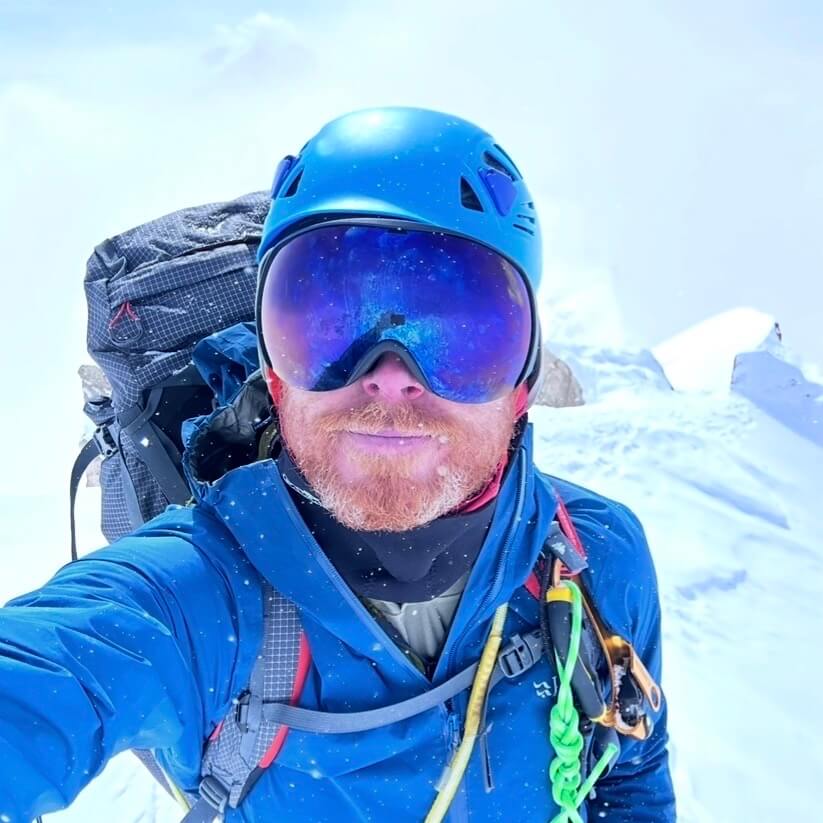
Mount Elbrus is the highest peak in Europe and was my third climb of the Seven Summits. Everything about the trip was unforgettable. It felt surreal to experience the food, drinks, people, sights and sounds of Moscow and the Caucasus first hand. I’d love to travel a lot more of Russia when the world is more stable, ideally on the Trans-Siberian Express, but for now we felt safe and welcome in the areas we visited.
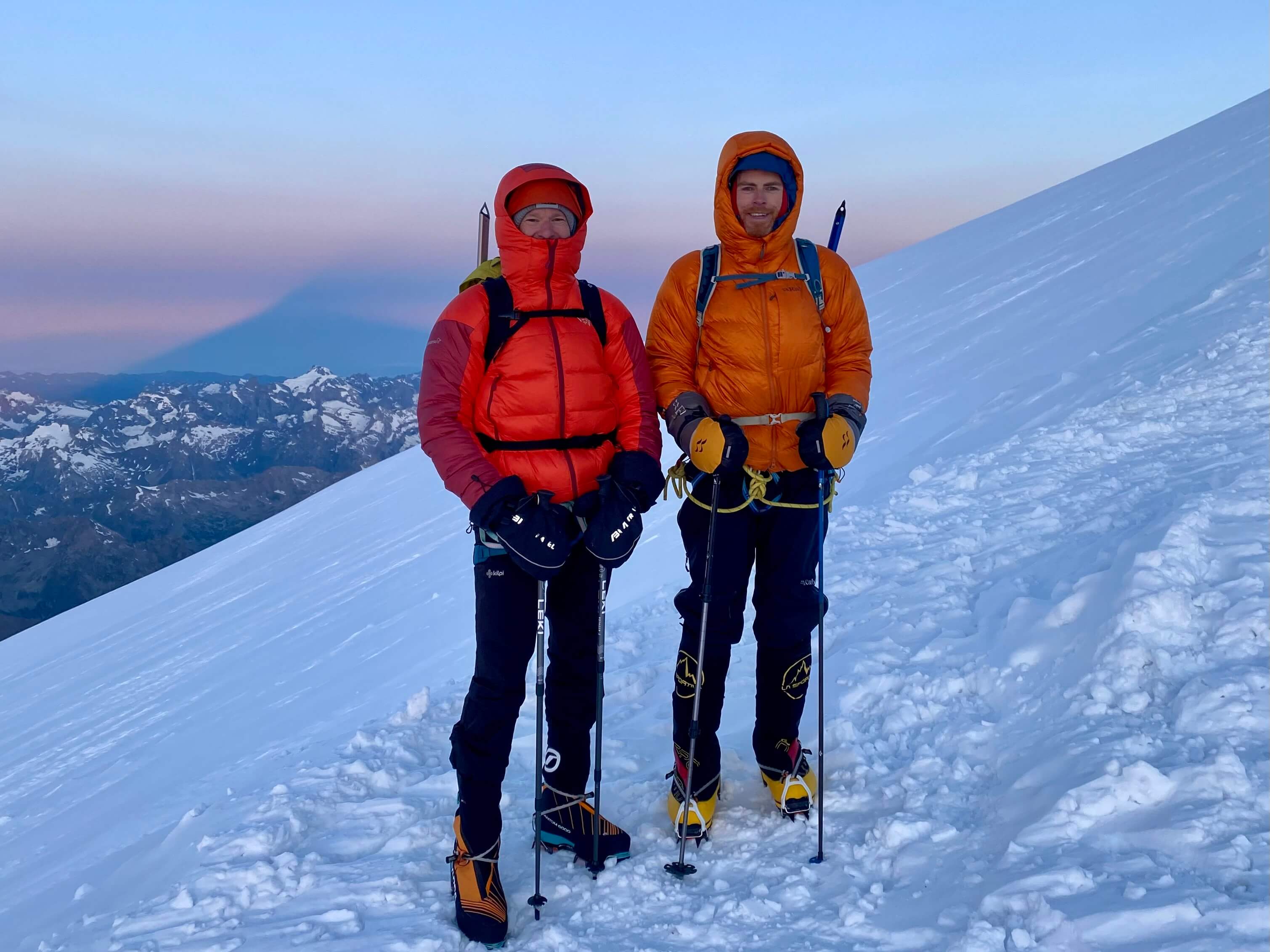
Our preparation went well, including five days of acclimatising in the mountains, but it was still incredibly difficult. The elevation gain on the summit night is double that of Mont Blanc and 1.5 times that of Kilimanjaro, while also being steeper and more technical, with lots of exposure and some fixed lines. It was a proud moment when Adam Creagh & I persevered through a 13hr summit bid to reach the peak at 9:00am on July 29th 2024.
This is the story of that climb, including all the lessons we learned along the way.
Background
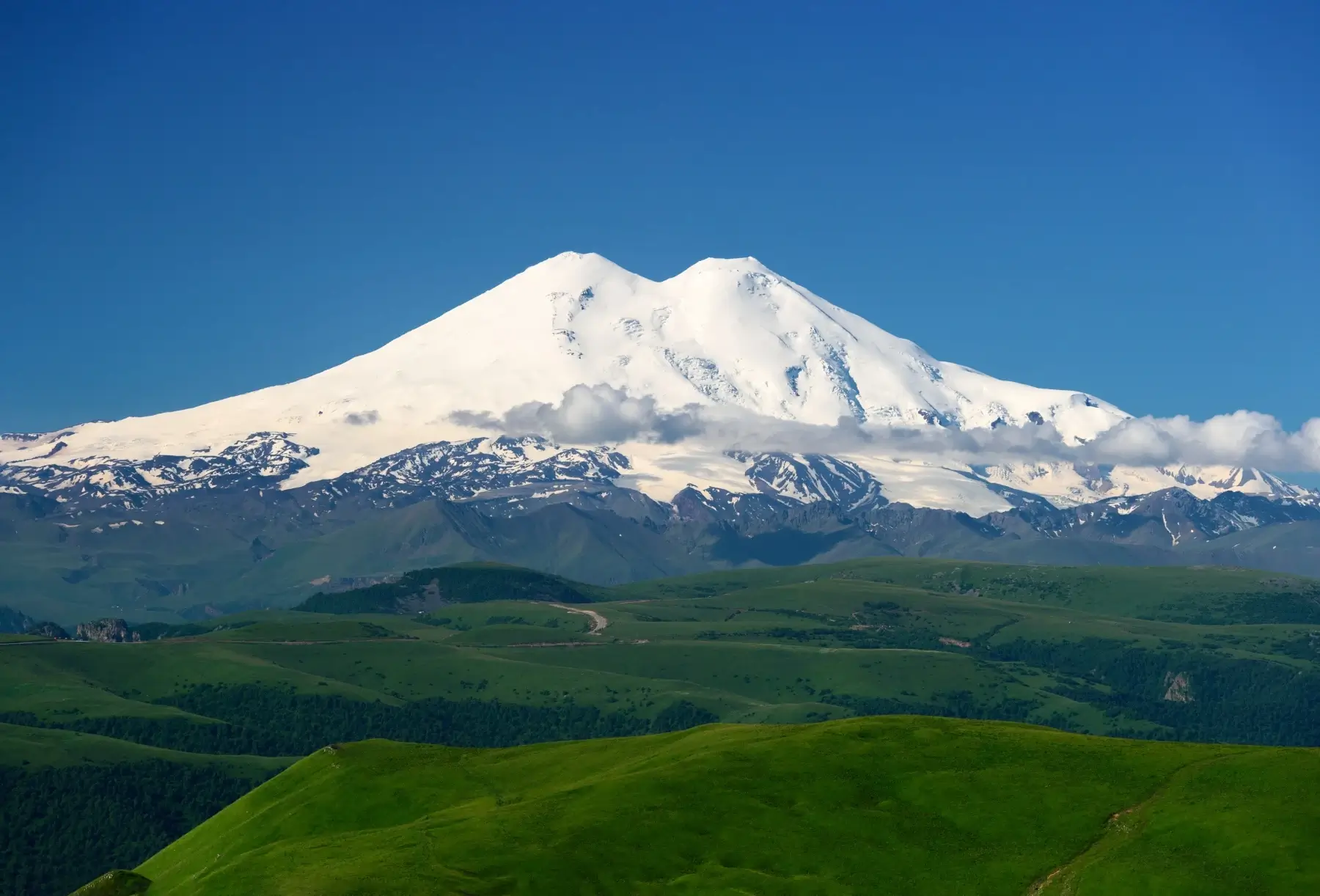
Elbrus is a dormant volcano in the Caucasus Mountains of Russia, about 10km from the Georgian border. It’s the tenth most prominent peak in the world, with its iconic twin summits dwarfing everything else in the area. From the top you can see both the Black Sea & Caspian Sea on a clear day. It’s the highest point in Russia and, as it lies west of the Eurasian border in the Ural Mountains, is also the highest point in Europe.
The name derives from the Turkish Alburoz meaning white mountain, and the Persian Alborz meaning High Sentinel (also the name of a mountain range in Iran). In Greek mythology it’s where Prometheus was chained up by Zeus and tortured as punishment for stealing fire from the Gods. In local legend it’s said that the once singular peak was split in two as Noah’s Ark passed over it.
Elbrus is covered in a heavy year-round snow, which filled any volcanic craters long ago. Strong winds bring the cold, difficult conditions the mountain is known for. As such, winter ascents are rare. In 1829, a Russian army scientific group was first to reach the lower East Summit at 5,621m. It wasn’t until 1874 that an English expedition found a safe route across the deep saddle to reach the West Summit at 5,642m.
From there it played a part in history as a battleground in World War 2, hosted international races that pitted the Soviets against Americans, and has seen records like horseback summits and the highest ‘driven’ Land Rover, which summited in 1997 after 43 days of being winched up! Elbrus is most known for being the training ground where some of the world’s best mountaineers prepared for the Himalayas, including at times Anatoli Boukreev; the hero of the 1996 Everest disaster.
Low costs and dramatic scenery have made the Caucasus popular with tourists. In summer it’s known for world class hiking, mountaineering and the famous thermal baths that give the closest city its name; Mineralnye Vody meaning Mineral Waters. In winter it’s known for skiing and snowboarding, being close to Sochi which hosted the 2014 Winter Olympics. Tourism has turned more domestic in recent years, but is no less busy.
Planning & Logistics
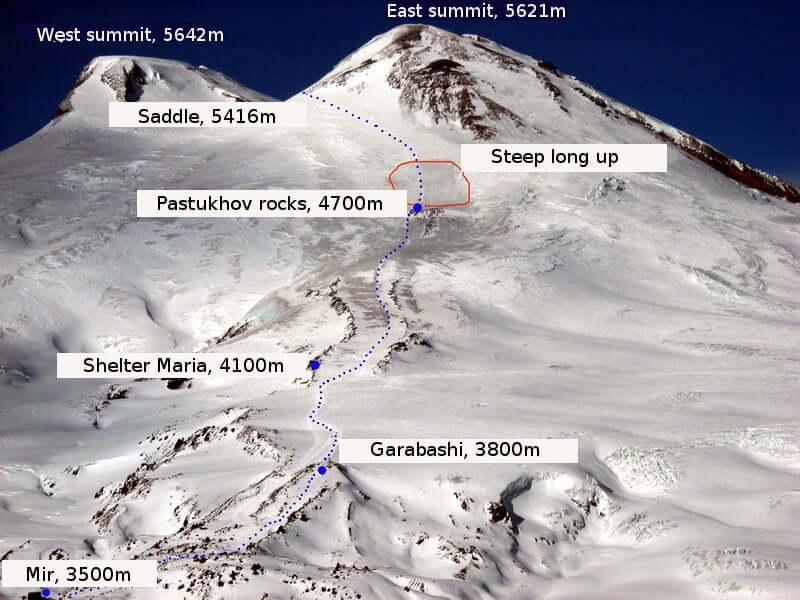
Two routes are most common because they minimise crevasse and avalanche risk. The North Route is more remote and adventurous, but traverses the lower East Summit where some guides have been known to turn rather than cross the final 1.5km through the saddle. To avoid that risk entirely we chose the more popular South Route. This follows Europe’s highest cable car from the town of Terskol to Garabashi Station at 3,800m, up past the Pashtukov Rocks, into the saddle and directly to the summit.
Ascents are typically done between June & September, and we chose late July for more consistent weather. We booked an all-inclusive guiding package with a local company; Elbrus Tours. They would pick up and drop off at the airport in Min Vody, simplifying logistics. Ekaterina in their office was incredibly helpful in the lead up, and the trip was made very simple for us while there. Their eight-day programme included all transport, accommodation, food, drinks and mountain guiding for a cost $1,050 each. We planned to spend time in Moscow before and Istanbul after to make it a two week trip.
Getting a Russian visa was an easy process, for Irish at least. They use an online e-visa platform and I had mine approved after one hour. The cost was $52. Booking flights was less easy, which means it’s time to address the elephant in the room.
Since the Russian invasion of Ukraine in 2022 several sanctions have affected what tourism to Russia looks like, such as there being no direct flights from Europe. Western banks also refuse all payments to Russian accounts, and you can’t use Visa or Mastercard in the country. I had been offered a local Russian MIR card by a friend who foresaw the headaches we’d have, but we decided to make it work without. Here’s what this looked like for us travelling in 2024:
We booked return flights to Moscow via Istanbul with Turkish Airlines. Most of the world still flies there and it was easy to book, we just missed out on any cheap Ryanair options. Internally we had a return flight from Moscow to Min Vody with Aeroflot, this was booked through an online company in Dubai. We sent our deposits to Elbrus Tours via their Western Union contact in Bulgaria, with the rest in cash on arrival. Then we emailed a hotel in Moscow who also agreed to cash on arrival.
My favourite mountaineering insurance is the Austrian Alpine Club, but they along with all western companies refuse to cover Russia right now. We got an Elbrus specific travel, rescue and medical insurance through Save Pro Life who are based in Moscow and deal regularly with foreign climbers. We had trouble paying but thankfully Elbrus Tours sent money on our behalf and we reimbursed with cash when we arrived. The cost was $100 each.
Payments are preferred in US Dollar so we changed enough before leaving, making use of the no exchange fee in Irish Post Offices (applies to USD & GBP only). They need to order in anything above $1000 so this takes about a week. We brought 20% contingency in Euro since we knew our cards wouldn’t work.
Gear & Preparation
Elbrus has been described as Kilimanjaro in an industrial freezer. Frostbite and hypothermia are huge risks, playing a major role in the 20 to 30 annual deaths; double that of Mount Everest. Having reliable gear and knowing how to use it is critical. The wind cuts through you and if your gear is insufficient or fails it won’t be forgiving. Everything can be rented, but we preferred to have our own.
For high altitudes you need one modular outfit to be worn every day, made up of well-considered layers that can be adjusted based on conditions. I took this opportunity to invest in gear that would work on everything up to Denali; the coldest mountain on Earth. My six top layers went from moisture wicking thermals to a heavy down parka. My four bottom layers went from similar thermals to down pants with full side zips for putting on over crampons. I chose two layers of gloves that worked for my hands and giant mittens for when all else fails. I had a lot of hiking clothes already, but dialling in this one system is critical.
The mountain requires double layer boots (6,000m spec) which Adam bought, but with future climbs in mind I chose triple layer (8,000m spec); literally a boot, in a boot, in a boot! I tried several brands during a trip to Andorra which helped as no shop in Ireland stocks them. The best fit with expedition socks were La Sportiva Olympus Mons, two sizes above normal. The final bits included crampons with anti-balling snow plates, a 90L expedition climbing pack, a -40degC expedition sleeping bag and an alpine style harness. I already had a good climbing helmet, ice axe and rated sunglasses; which are so important. This kit list had me completely overprepared for Elbrus, but well set up for future climbs.
I already felt comfortable walking with crampons and moving as part of a rope team so training for me meant hiking as much as possible. I also had a strong fitness base from recent marathons and adventure races. Adam prepared his snow skills on a winter trip to Scotland, and his own successful climb of Mont Blanc in May. This was a good chance for him to trial his gear and test his training, soon after which it was time to go. We both felt ready and excited heading for the airport, curious what Russia had in store for us.
Moscow
Our flights went to plan with a 2hr layover in Istanbul, then arriving to the hotel with all our bags. Any apprehension disappeared once we saw how clean, safe and friendly Moscow was. Soviet architecture gives a distinct look, with huge statues and cathedrals that make you feel tiny. The layout is clever with tunnels for every road crossing, allowing traffic to flow fast with almost no stops. The metro is the cities heart; never more than two minutes between trains and all stops have huge atriums full of statues, mosaics and chandeliers. It feels like there’s a separate underground world to explore and makes getting around cheap and easy.
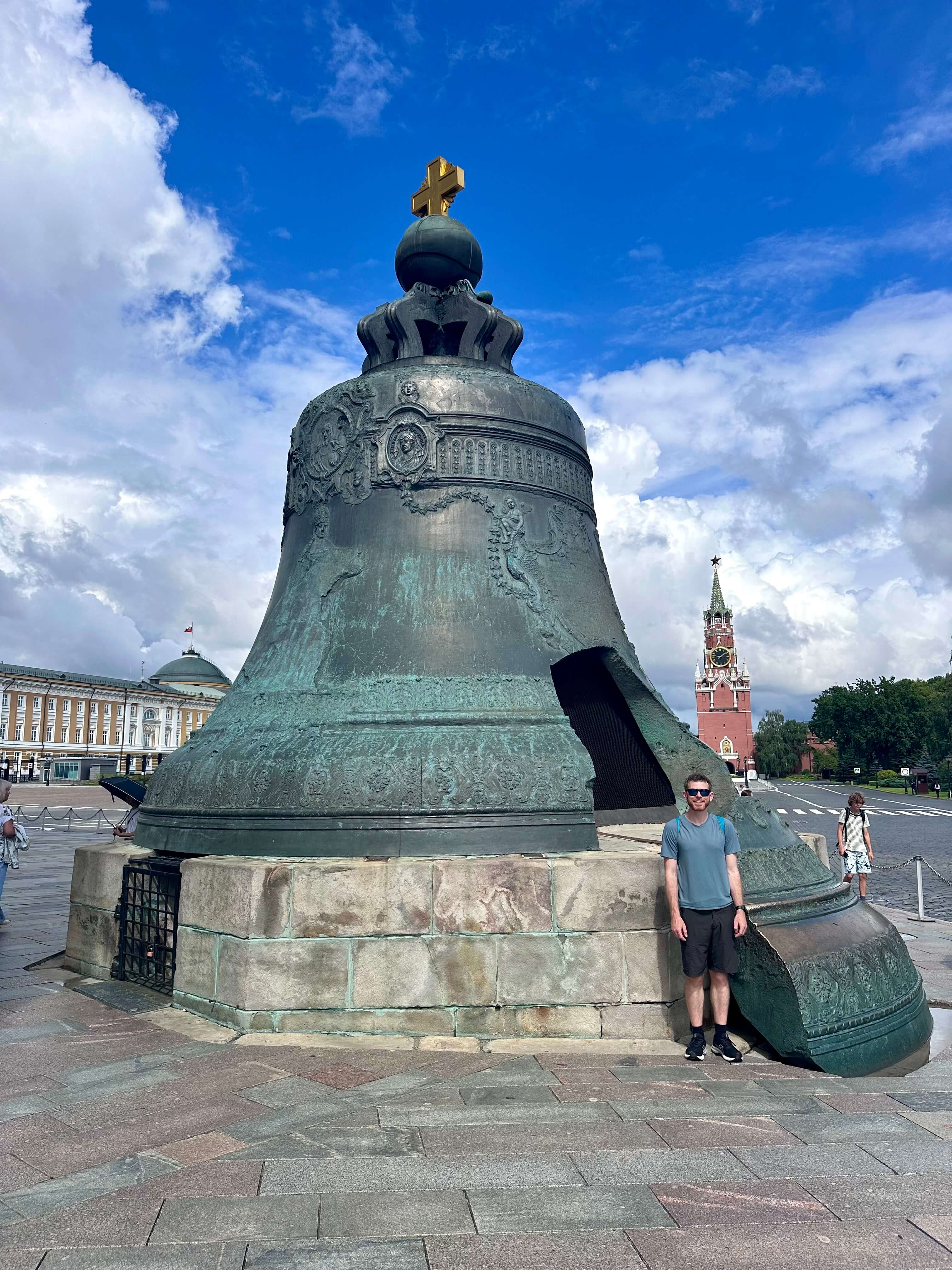
The Red Square and St Basils Cathedral were incredible. We went inside the Kremlin and saw the Grand Palace, Cathedrals, Armoury and Diamond Fund which holds the royal carriages, thrones, gems and fabergé eggs. We saw the giant Tsar Cannon and Tsar Bell; the largest bell in the world which cracked in a 1737 fire. Back outside we ate in the GUM Mall, saw the Grave of the Unknown Soldier, and the Kremlin Wall Necropolis which holds the graves of Josef Stalin, Yuri Gargarin and Lenin’s Mausoleum.
More exploring brought us to Gorky Park which had violinists and USSR looking ice cream stands. We walked the Moskva River which gives the city its name, passing giant statues like Peter the Great’s at 98m tall. I really enjoyed the amount of art around the city and thought the huge murals brought a lot of colour. We saw the Fallen Monument Park where removed statues from USSR times were thrown. A huge statue of Stalin lies face down in the grass and is used as a bench.
We were hilariously underdressed for restaurants but tried as much food as we could anyway. Pirozhki, pelmeni, pierogi, solyanka soup, beef stroganoff and the clear highlight of blini or Russian crepes. If I return, I’ll pack nicer clothes for Café Pushkin and the Grand Café Dr. Zhivago. We enjoyed seeing people eating light food and chatting while drinking about a litre of vodka each. To us the vodka tasted no better here, but it was an experience to try it.
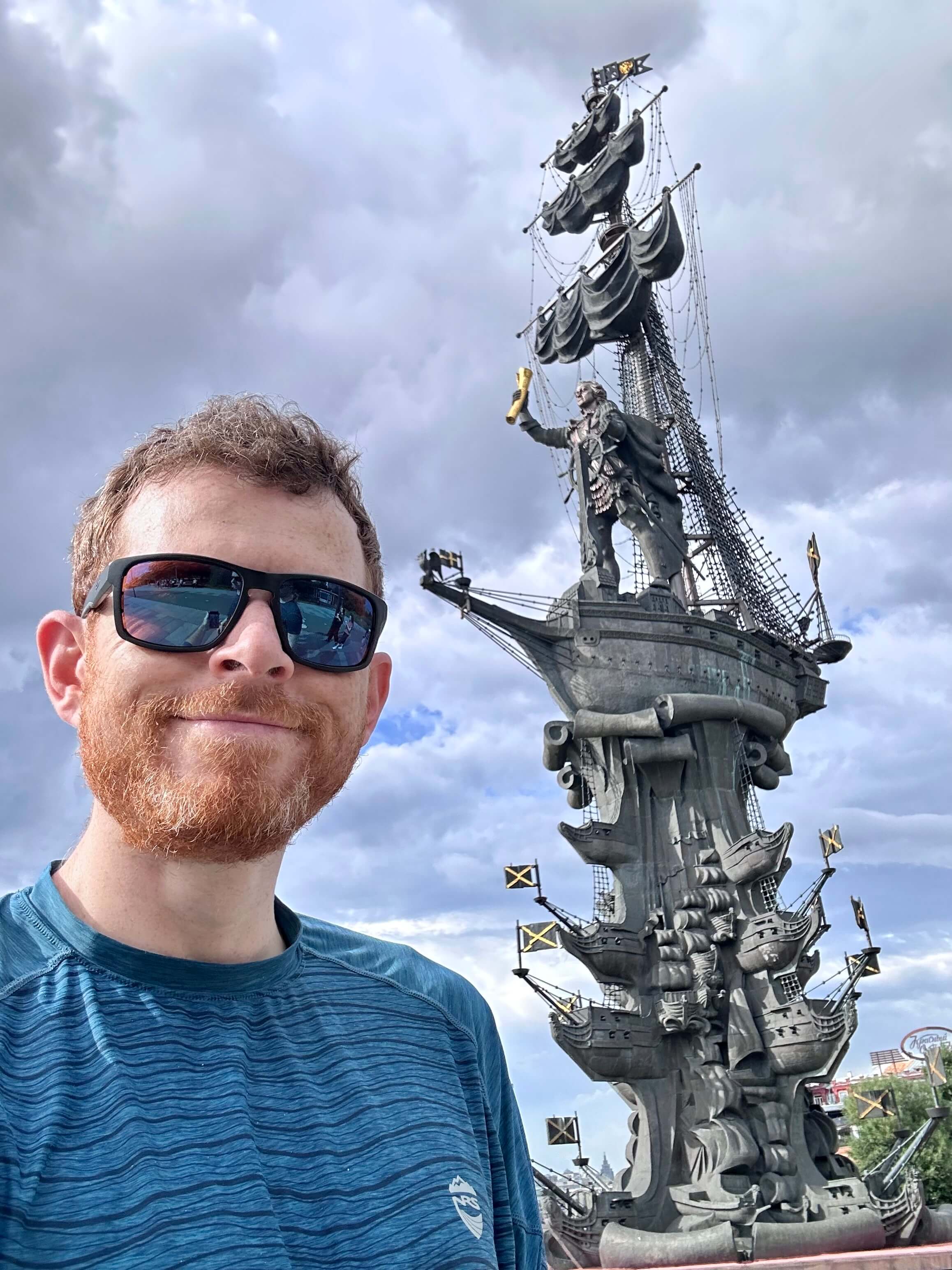
We had a lot of unknowns coming here in 2024, but found tourism to still be busy. I saw tour groups in English, Spanish & Chinese, as well as hop-on-hop-off tours by bus and boat. I’m not sure what we expected, being farther from the war than cities like Warsaw & Krakow, but we did feel surprised by how normal life was. Even McDonalds & Starbucks who made very public exits from Russia were open with slightly different names and identical menus. It made me wonder what the effect was of all the sanctions, seeing the city with the highest concentration of Billionaires still thriving with spotless streets, no homeless and fuel for 45 cent per litre.
We packed in a lot and had a nice experience in Moscow, but regretted not allowing more time. I would have loved to see the Cosmonaut Museum, Gulag Museum and the Exhibition Centre. This is a park full of small individual museums for each soviet country, and for everything from robotics and nuclear energy to cinema and arcade games. They have a cosmonaut one with space suits and an actual space shuttle, across from one for beekeeping. I know I’ll return in more stable times, probably for the Moscow marathon. When I do, I’ll leave plenty of time to see both the city and the national parks outside, which the metro goes all the way to on the same 50 cent ticket.
For now, it was time to wave goodbye to Moscow as we flew south to Min Vody.

Arrival in the Caucasus
We were greeted at the airport by Pavel, who made short work of the 3hr drive to the mountain. It was warm and sunny on route, staring up at the twin volcanic peaks which look out of place so high above the rest of the range. We were dropped to the remote ski village of Terskol and could feel the slight chill of being at 2,250m. We checked into what looked like an old Alpine chalet where we met our lead guide Viktor.
Viktor is a man of few words, who was always meant to be a mountain guide. His mother has climbed Everest & K2 without oxygen and his father has climbed other 8,000ers. Having been raised in the mountains he and his three siblings are all guides. He works primarily in Russia, Georgia, South America, Africa and Central Asia. I asked him a lot about his favourite climb; Muztagh Ata (7,546m). It’s in the Pamir Range of Tibet in China but must be driven to from Pakistan, it takes a month to climb and has an 18% success rate. The name means Father of the Ice Mountains in local Uyghur and it sounds like a wild experience.
As the day went on, we met the other six climbers who were all our age. Alexey, Dasha, Marina & Lada from Russia, Shamil from Kazakhstan and Wang from China. They had a mix of basic hiking experience on smaller mountains, some rock climbing, but very little on snow or at high altitude. Everyone had good English and we bonded over their unique stories, like running the Moscow Marathon, remote travels to Kamchatka in Eastern Russia, or having met Alexei Navalny (there was a very strong dislike of Putin in every young person we met). The meals were buffet style, basic but filling, and the views out every window were like a postcard.
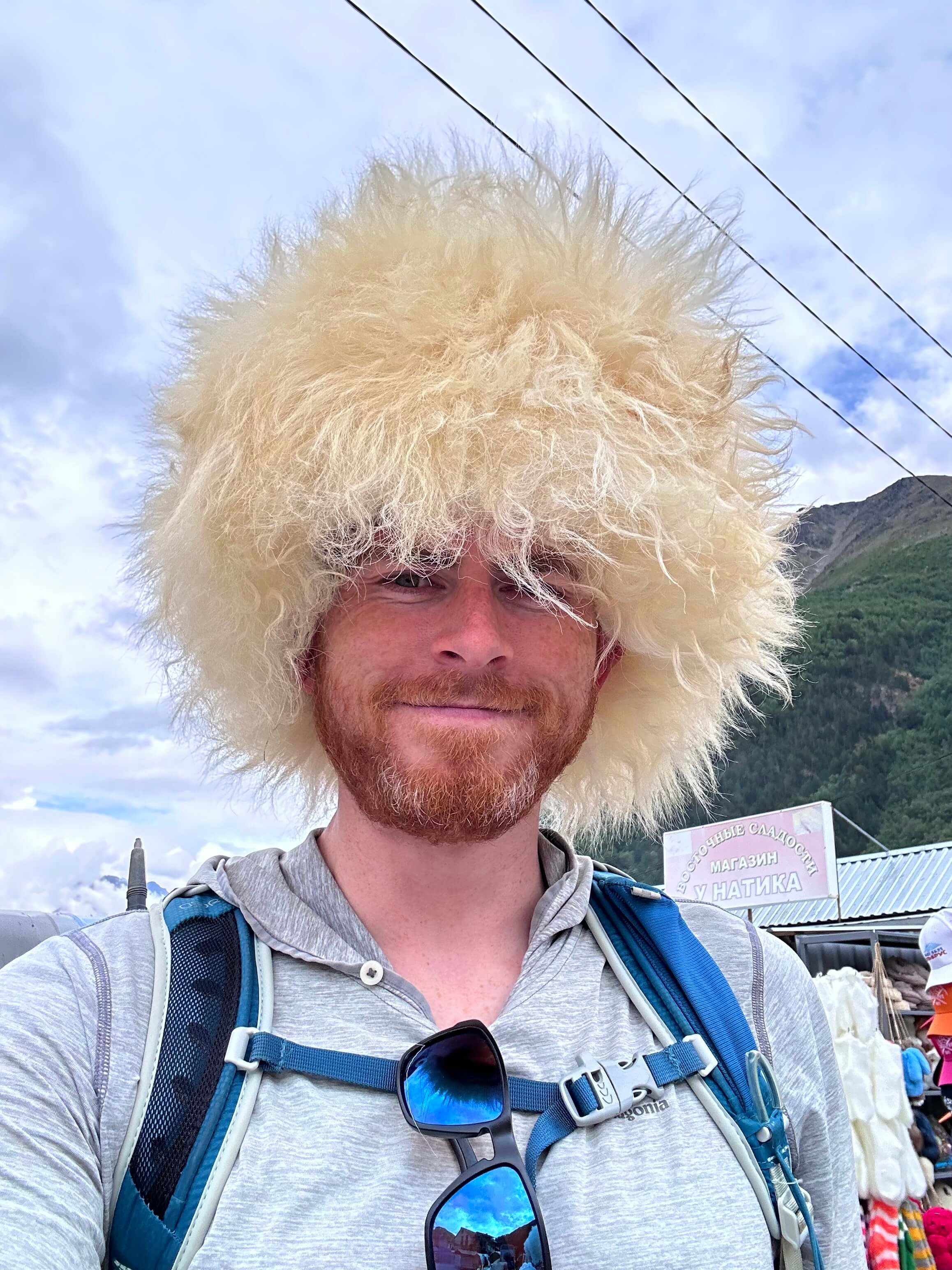
Our gear was checked in our rooms and those who needed more were brought to rental shops. Adam & I didn’t need anything extra so went to explore the town which centred around nice bars and cafes at the foot of a ski lift. There were lots of tourists around and I enjoyed looking through the local souvenirs like the sheepskin hats called papakha. Over dinner we got a full briefing of what our week of preparations would look like.
Acclimatisation Day 1
Terskol (2,250m) to Cheget 3 (3,100m)
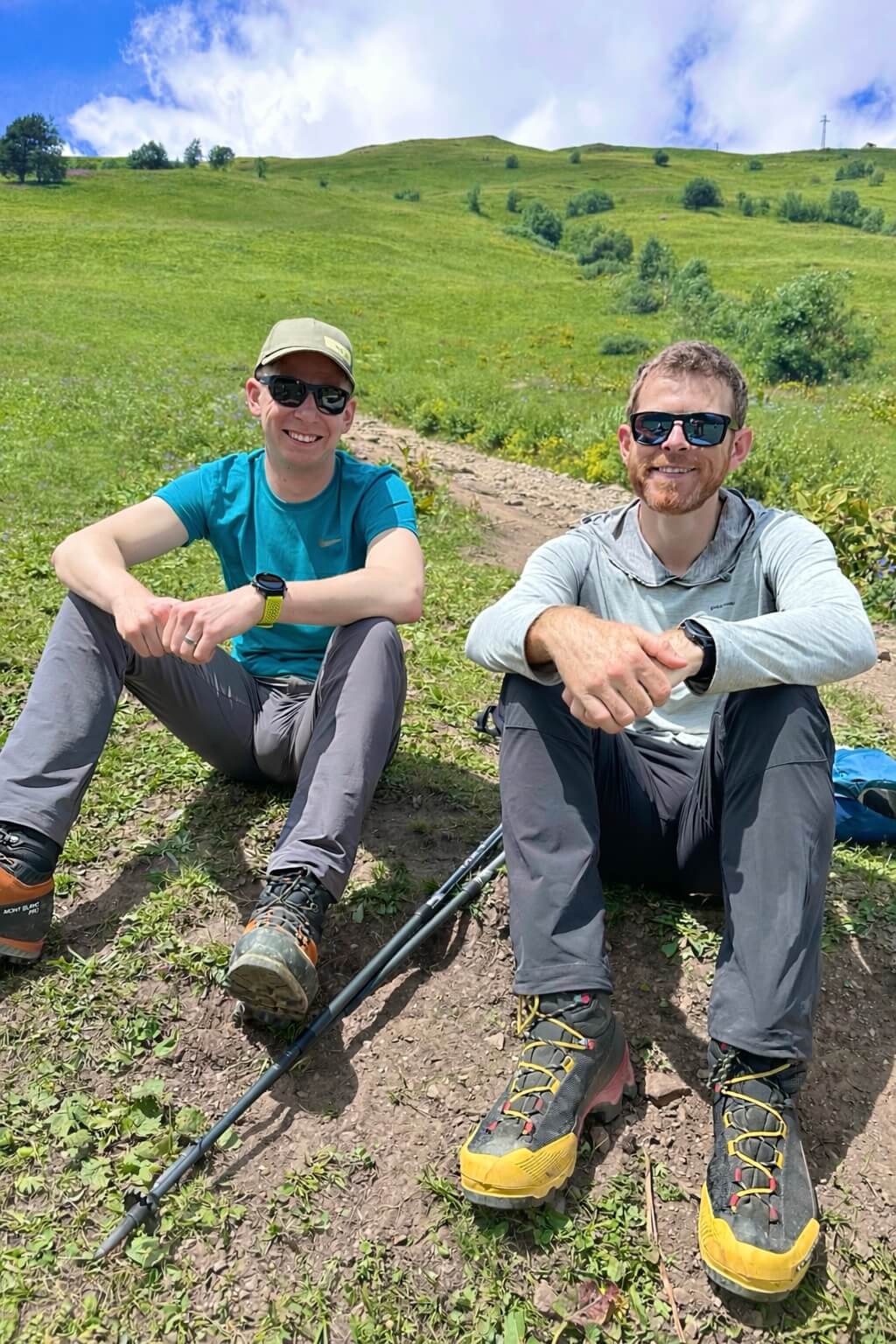
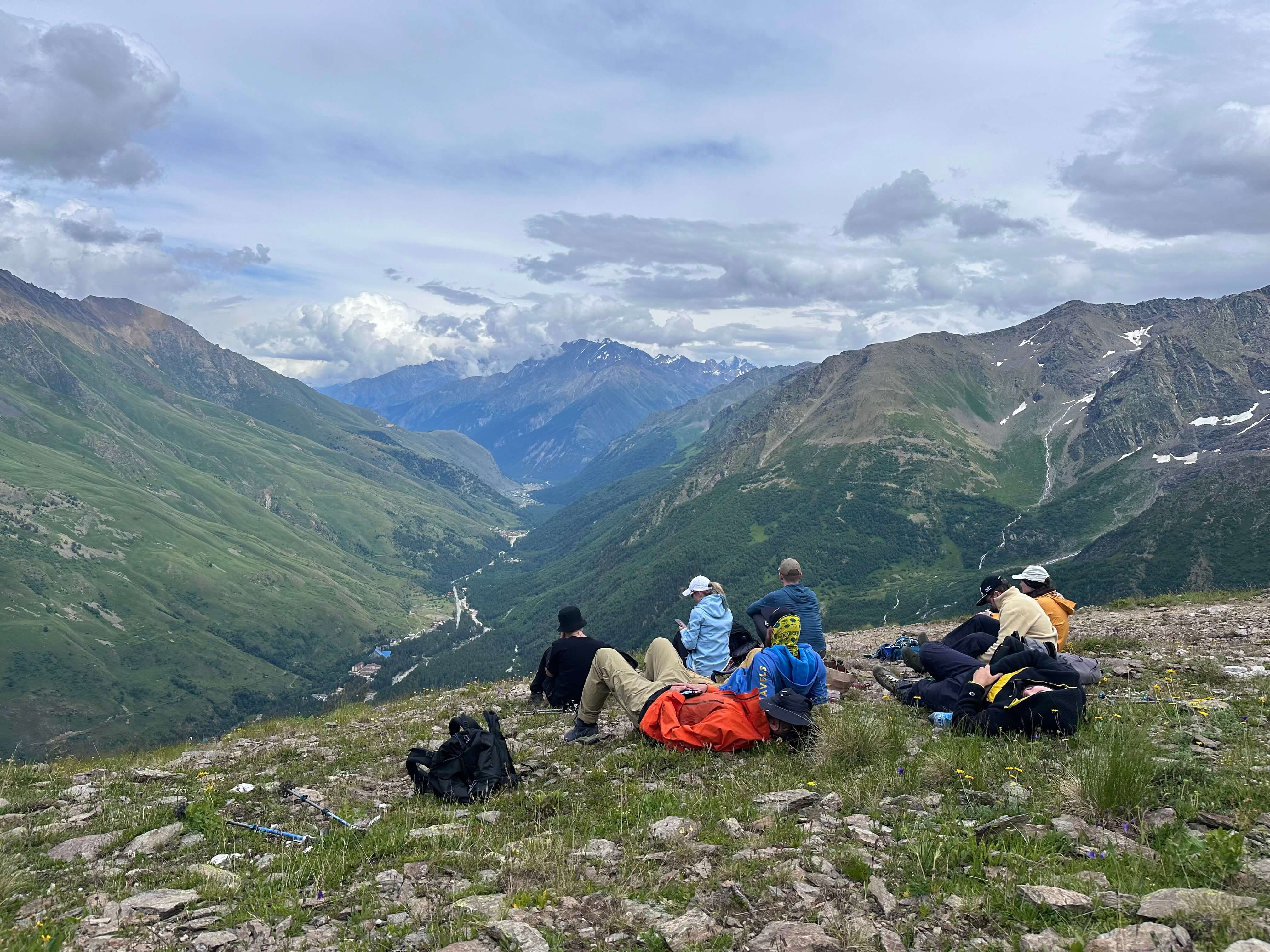
After breakfast, we began our day by walking under the nearby ski lift towards Mount Cheget. The trail starts steep which let us get a feel for the slow pace expected up higher. It was a chance for some to get used to their rented gear and for us all to get to know each other. The top levelled out and brought amazing views of the valley, but Elbrus stayed hidden behind another hill all day. We had a long stop for lunch on a high plateau, admiring a brown husky which looked at home in the hills, before descending on the ski lift. A short taste of thinner air, followed by a night of good food and rest.
Acclimatisation Day 2
Cheeper-Azau (2,950m) to Elbrus Lake (3,250m)
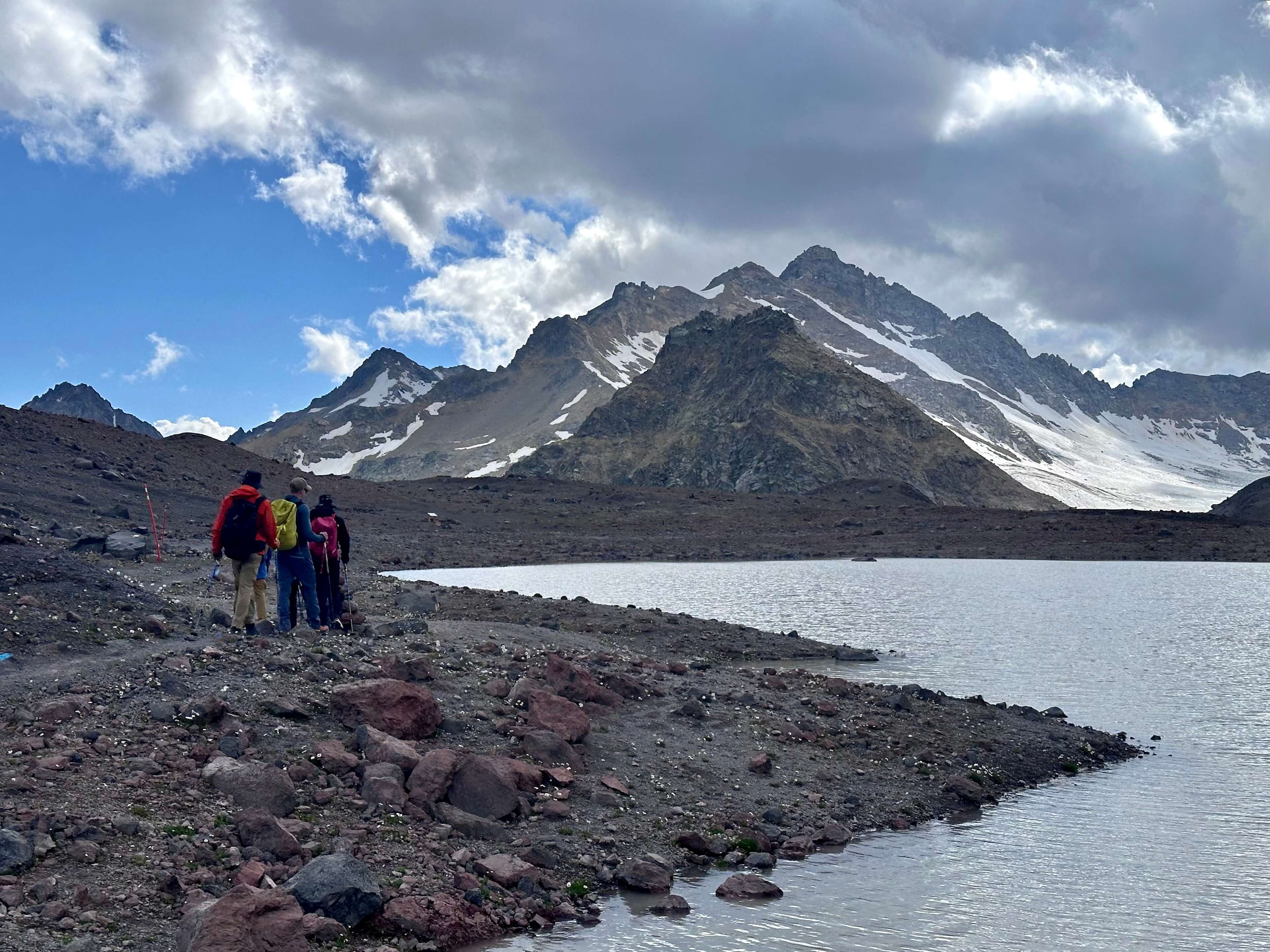
The next morning, we moved all our things to the Hotel Cheeper-Azau. This is accessed from the Garabashi Cable Car, sitting just below the Stary Krugozor Station (3,000m). After dropping our things off we walked up along the lift path, then diverted over a small bridge and rocky moraine to a lake at 3,250m. The original plan was to go higher but based on the group Viktor decided this was enough, so we stayed at the lake for an hour, talking, eating and acclimatising as best we could. Then descended slowly for a cosy night of hot chocolate and guitar high above the town.
Acclimatisation Day 3
Garabashi (3,800m) to below Pashtukov Rocks (4,300m)
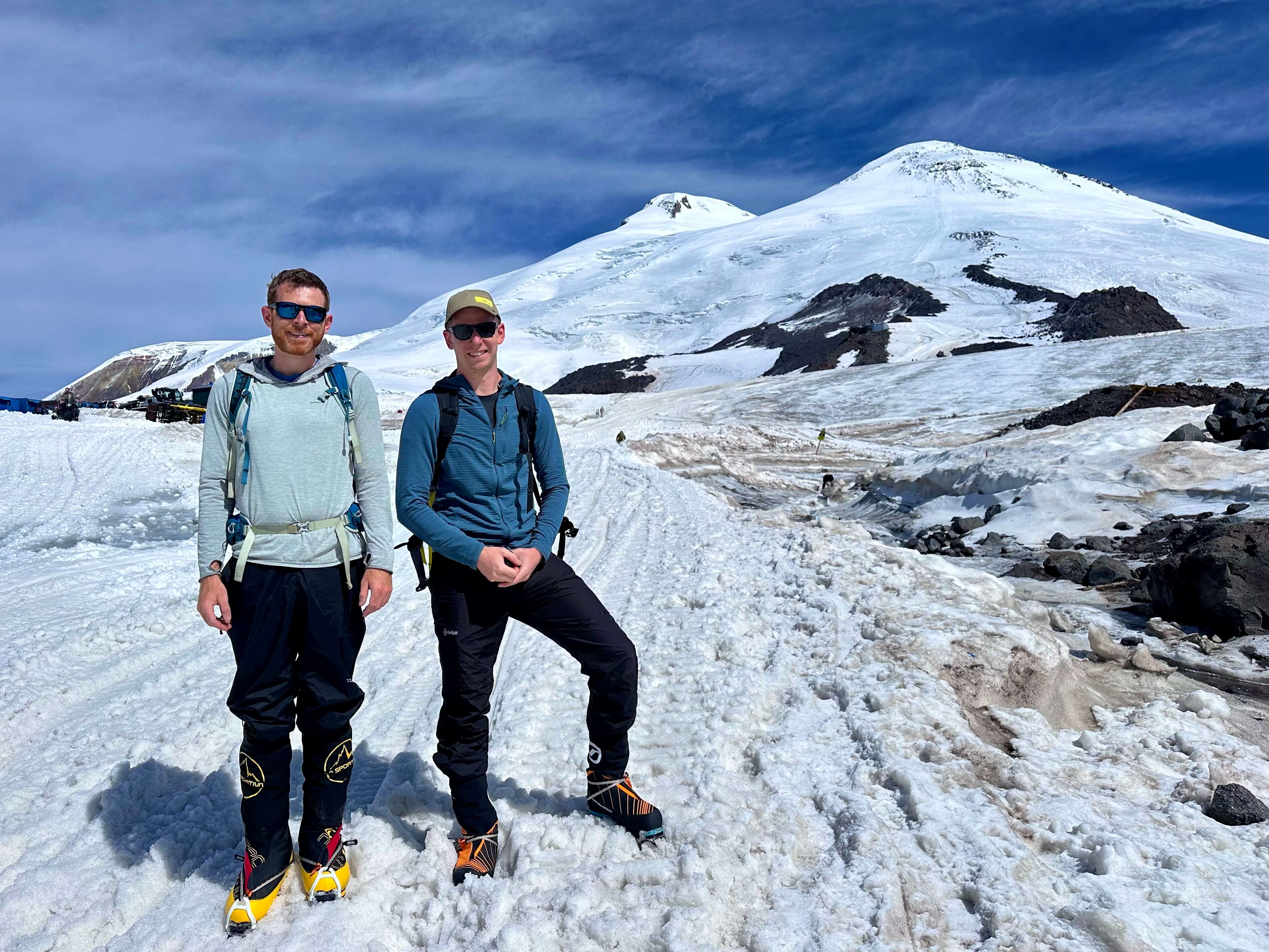
After breakfast we packed our bags and moved them to their final home at Garabashi Station. This is famous among mountaineers for the iconic barrel huts, which serve as the base camp where climbs begin. From here the mucky trails finally become snow, there’s a frosty chill in the air and the views are incredible, especially of the twin peaks. The station was packed with tourists taking photos, and every time one of us moved Viktor would remind us to go slowly!
We left our things in the large reception area of the Leaprus Hotel and put on our snow gear and crampons. From here we hiked to the Pashtukov Rocks; a jagged ridge which provides the only shelter along the route. The climb was easy and slow. Struggles in the group required us to turn early at the bottom of the rocks rather than at 4,700m as planned. This being the second day this happened was frustrating. After a break for lunch, we headed back down for food and rest.
At this altitude simple things require more effort. The group were experiencing headaches and nausea but so far, Adam & I felt strong. We were leaving nothing to chance, drinking 4 to 5L of water a day since arriving, eating loads of food despite decreased appetites, taking daily vitamins and forcing ourselves to breath deeply. I did have trouble sleeping at this altitude, which was exacerbated by the long walks to pee at night (should have brought a pee bottle), but I still rested as best as I could. Adam on the other hand can sleep anywhere which I was very jealous of.
Acclimatisation Day 4
Snow Skills & Rest
This was to be our final day of preparations before leaving late that night. It was spent doing a refresher of crampon technique, using fixed lines, moving as a rope team and self-arresting using an ice axe to ensure we wouldn’t slide into oblivion if we fell off any of the exposed slopes above. It was treated with a warranted seriousness given the coming risks, and by the end of the day everyone had the basics.
Adam & I were feeling strong at this altitude and this was a nice day of moving around the slopes. Later it was confirmed a storm was coming and our summit bid would be delayed to the following night. At the time it was stressful, knowing this was pushing into our only contingency day and fearing what may come from the slower pace that comes with this larger group. We just controlled what we could, stretching our legs by exploring the camp before the near blizzard conditions arrived, then a day of playing cards with everyone inside.
The Snowcat Problem
There was a big discussion at this point between Viktor and the group, pertaining to what I refer to as the deep dark secret of Elbrus. It’s left out of a lot of accounts that 95% of climbers use a truck sized snowmobile named a snowcat to get to and from either the Pashtukov Rocks at 4,700m or Kosaya Shelf at 5,100m. From these points it usually means an 8-hour summit night to the peak at 5,642m.
Viktor was aware before and at all times during the climb that Adam & I would not be using the snowcat, and would hike from here at 3,800m. He pressured us hard now though, since the rest of the group all needed to be dropped to the highest start. He only had one more guide coming to join for the climb and feared the logistics of having us match our pace to meet the group as they got off the snowcat, knowing he needed both guides for the large group above. In hindsight his worries were justified, but weren’t handled well at the time.
After a lot of stress, we finally found the obvious solution. Adam & I paid an extra $50 each to have a third guide come for just us. We would have no requirement to meet the other group on the climb and could move up and down at our own pace. It left the other group with an even better ratio so everyone was happy. The new guides came up the night before the summit bid to meet us for dinner. We went aside after with our guide Alexey who checked our gear and got to know us ahead of what we knew would be a big night.
The others would get on their snowcat at 4:00am and be dropped to Kosaya Shelf (5,100m) at 4:30am. They would aim to summit around 10:00am, well ahead of the strict turnaround time of 2:00pm, then descend to Kosaya Shelf to take the snowcat down. We on the other hand, would be having a light breakfast at 10:00pm, to begin hiking at 11:00pm, in hopes of making the same summit time. As the storm died off and the alarm loomed, I found it impossible to get any sleep. I estimate I’d had 2hrs sleep over the past 48hrs when the alarms went off.
Summit Night
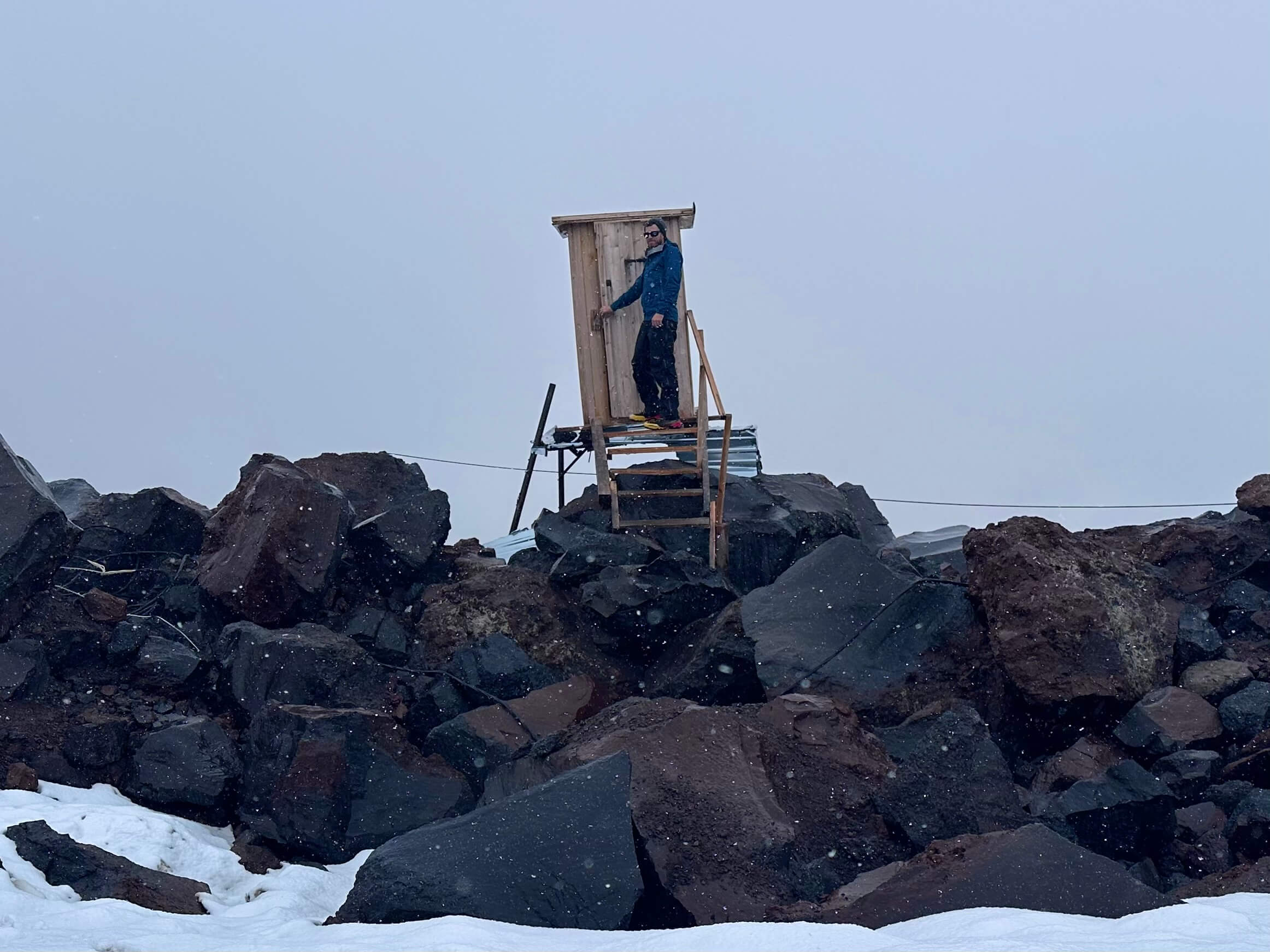
The light breakfast felt wrong to eat, but we forced it down. It was quiet and solemn as we put on our boots in the reception area and went out into the calm night. The mountain was still with almost no headtorches ahead of us, given the small few who hike from here. It felt special, seeing the summit glow above us. Not long after starting we put on our crampons, roped together, and with ice axes in hand we began the ascent. This was just after 11:00pm.
The mountain is simple in a sense. It’s not like Mont Blanc where you meander through crevasse fields and follow complex routes over ridges or false peaks. Instead, it’s dealing with very long and very steep snowy slopes. Some of which have a lot of exposure (fall risk) that requires careful footing. You can see the way, but actually climbing up something so steep feels never ending.
Alexey preferred to zigzag but all the extra walking and turning it brought got old after about an hour. Instead, we went straight up. There were good steps kicked in from all the groups who had done acclimatisation hikes, and we just kept the pace slow and controlled. We made use of the rest step, a technique that pauses in the least fatiguing position, and pressure breathing which forces more oxygen into your blood. Adam was very strong through the night. My body felt great, but I struggled a lot with tiredness.
In the distance we could see a thunderstorm over the Georgian breakaway region of Abkhazia. It was the craziest lightning I’ve ever seen, reaching a peak around 1:00am when the flashes would light up the sky every second. We would stop for a sip of water and short break once per hour and in these I felt hypnotised by the storm. Above us the conditions remained perfect. Eerily calm, seeing only a few other headtorches now behind us. We also passed someone in a small tent at the top of the Pashtukov Rocks around 3:00am.
Shortly before 4:00am the first snowcats began to pass us. We didn’t know it but our group was on one of these, starting earlier because Viktor was worried about timing. At this stage we were well above the Rocks, following our rhythm through the never-ending slope. At the same time, we saw the first light of sunrise, which I knew would finally end my battle with tiredness.
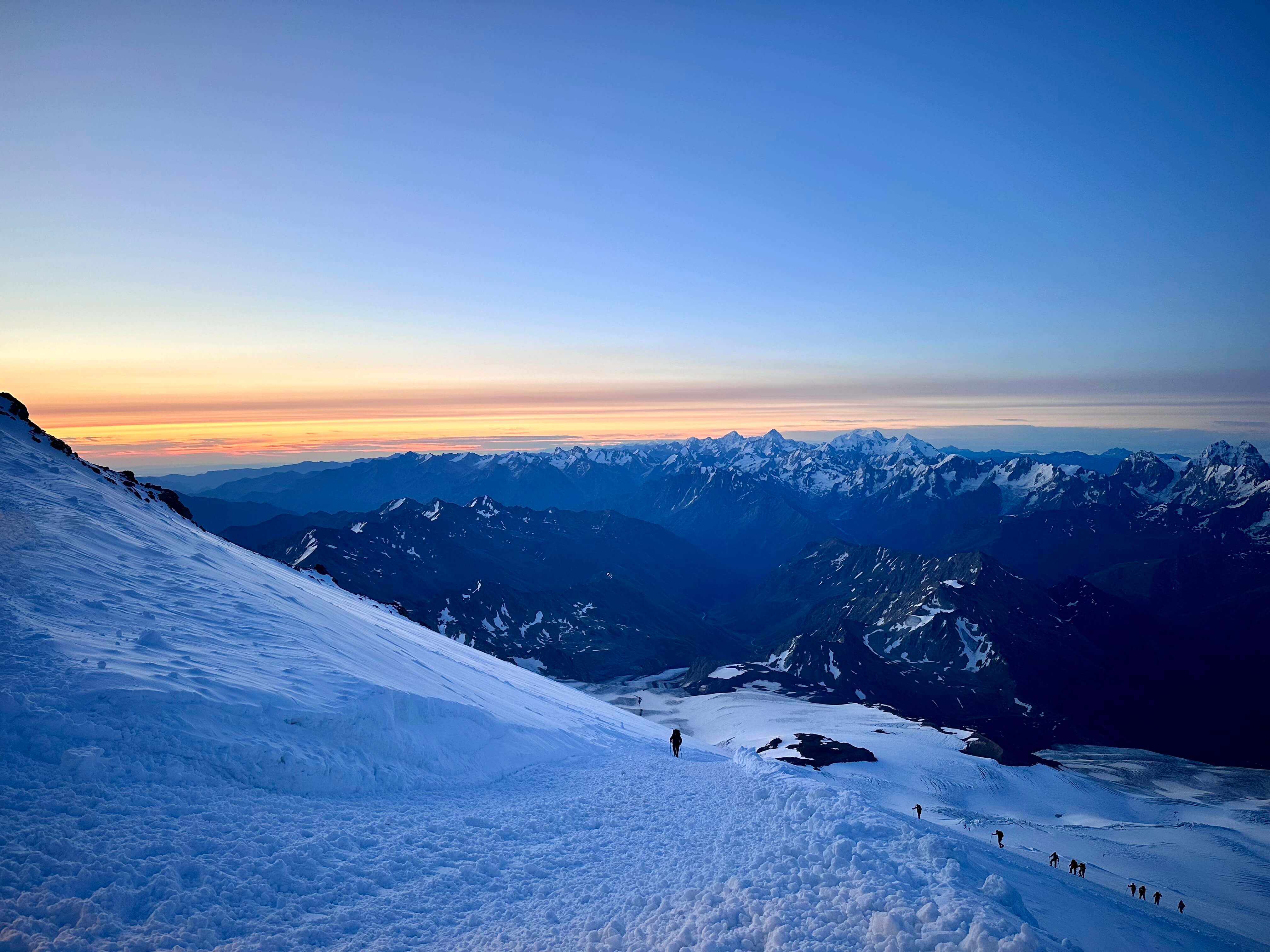
At 4:40am we reached Kosaya Shelf and took our only long break. We sat with biscuits and tea watching the full colours of sunrise, as snowcats offloaded groups behind us. Alexey was happy with our progress, and we were having a lot of fun with him too, finally making him laugh even! We continued around 5:00am, just as we’d started to get cold.
From here the route shifts from a wide snowy slope to a slim, curving one with huge exposure to the left side. It’s actually quite nerve wracking because I can’t imagine self-arresting would work at that angle. We were careful with rope management and our crampons through this section, also avoiding the soft outer edge. At 6:15am we finished the traverse and the slope finally levelled out as we entered the saddle. Both peaks felt imposing around us, and our eyes were drawn to the summit on our left, then to the sprawling view behind us.
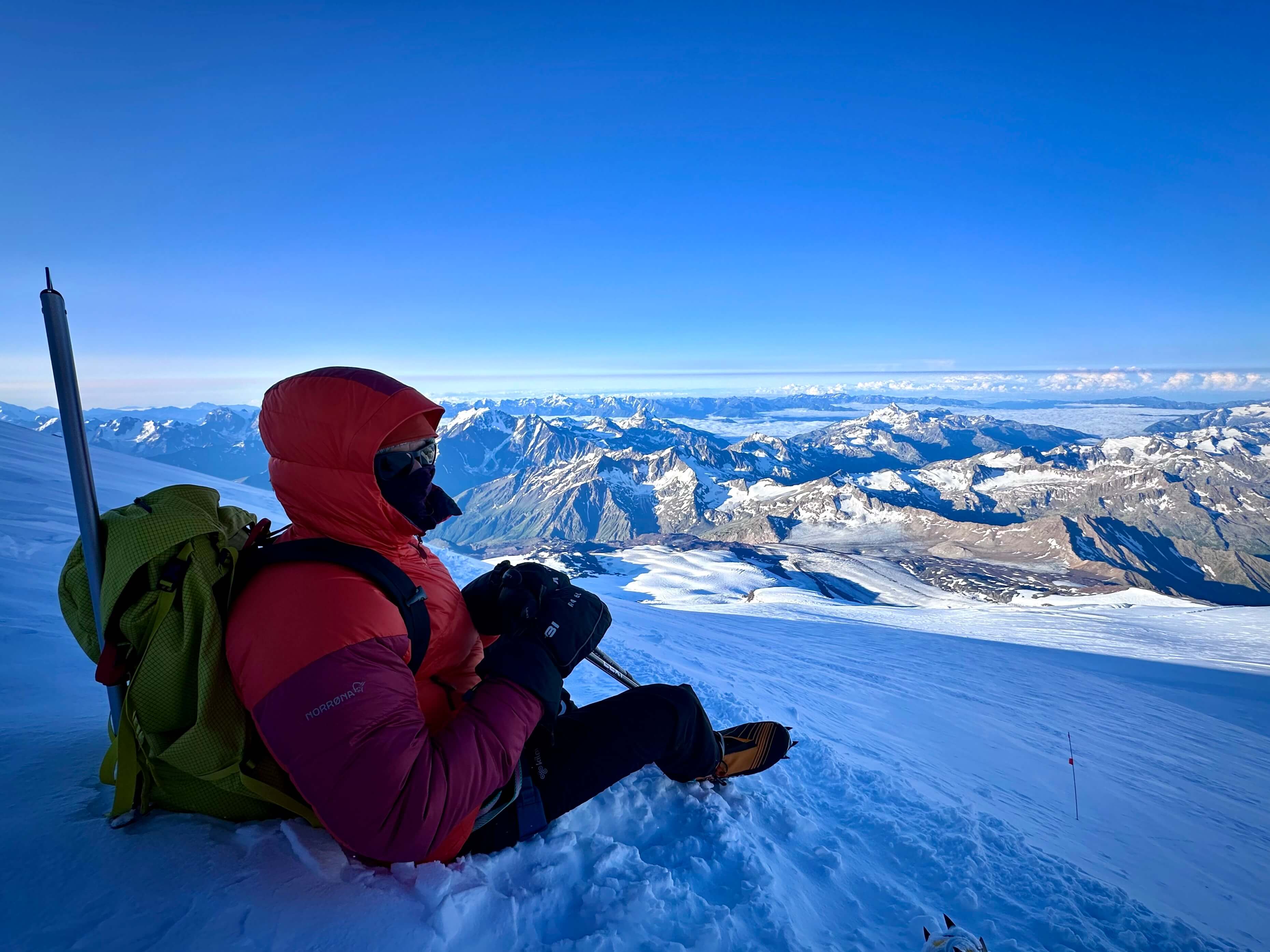
The sun had risen fully now. It was still very cold, but the sun gives an energy that can make the most difficult situations feel more bearable. Through the saddle we had some small cracks and crevasses to avoid as we made our way to the last snowy face. This is probably the steepest section of the climb and falls from here down into crevasses have led to a lot of deaths. As such ropes are fixed across the face that are mandatory to clip into, limiting possible falls.
As you move you switch to the next rope, and on this busy day it caused a bottleneck where people were either too inexperienced or too tired to move efficiently. A lot of people had trouble using carabiners with cold hands, and I felt guides seemed to be hand holding more than I thought was reasonable in an environment like this. I suspect the queues added about 45mins to our time traversing and moving up the face, which is time spent getting cold in an unsafe area. I didn’t like it, but I put up with it.
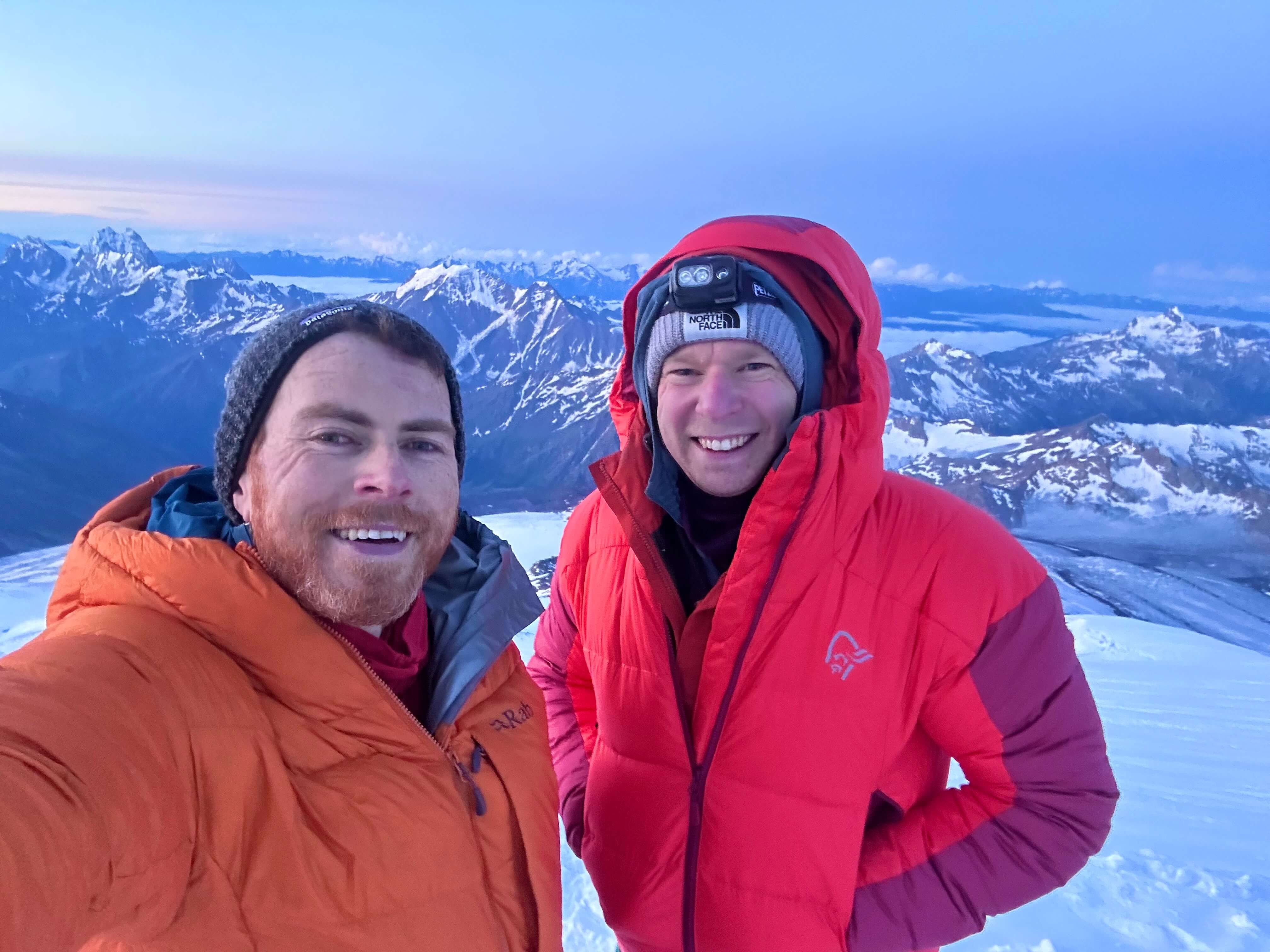
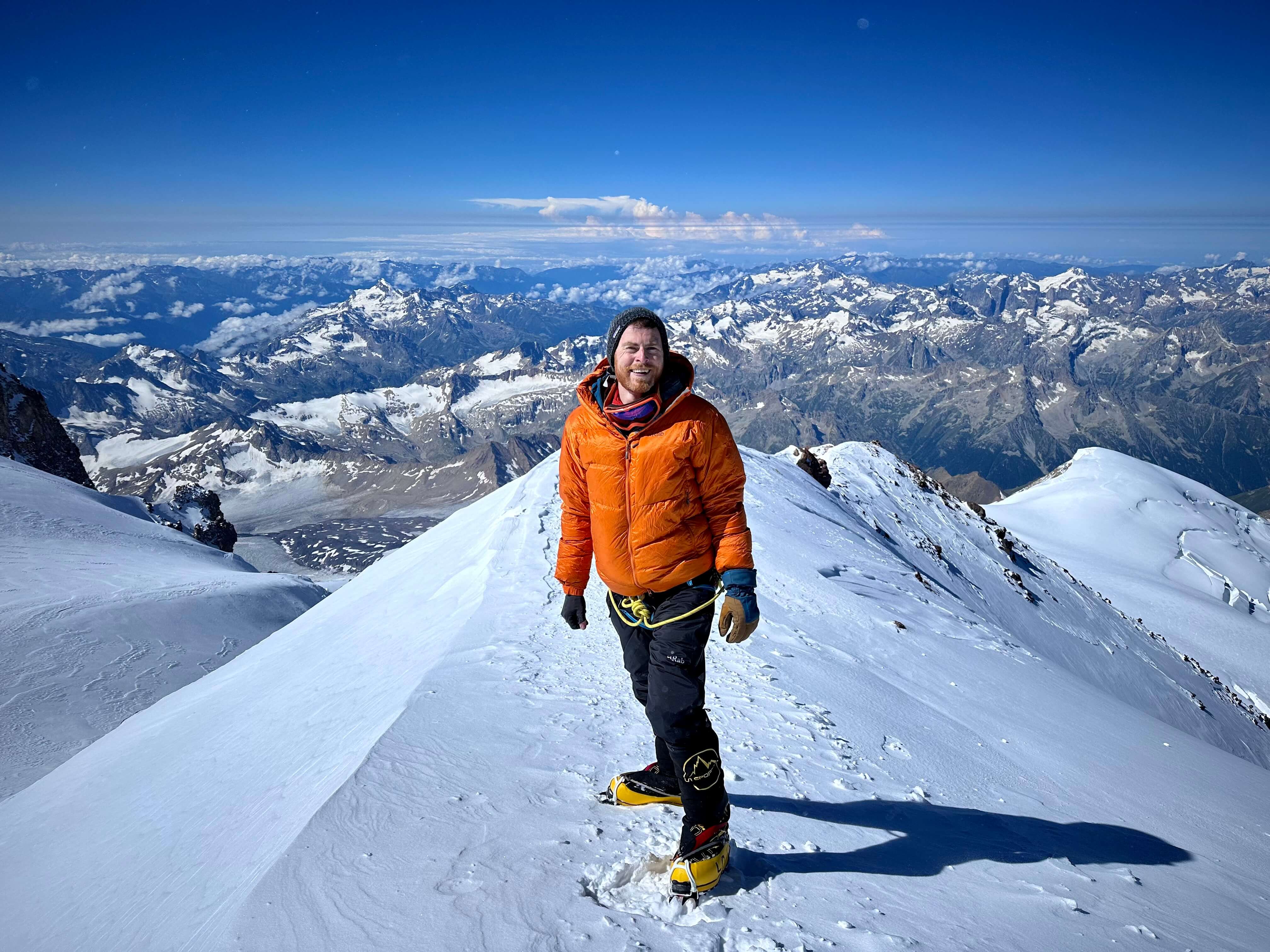
When we finally unclipped from the fixed lines we overtook several groups. In a relatively flat area, people leave their bags and walk the last slope to the summit. We attached ours to an anchor placed by Alexey so they couldn’t roll away, then made our way up the slope. It’s a fun moment, where the summit is now guaranteed, but still so difficult. Finally, we were standing on the top of Europe, far ahead of schedule at exactly 9:00am.

There was a strong wind on top but it was beautifully clear. I felt so thankful to have made it, having all stresses of weather and possible issues lift. It had been such a long night, with tiredness making it even more difficult than I had anticipated. There’s a manual summit counter that we added ourselves to by pulling the ice axe handle, then we took some time to soak it all in.
The descent was fast, using a separate set of fixed lines reserved for downclimbing which had no queues. We were back in the saddle and onto the endlessly long main slopes before we knew it. At the top of this we caught up to the rest of our group, who had been early enough to miss any queues at all, and had summited almost an hour before us. We had a break with them and then continued the descent together. At Kosaya Shelf some got onto snowcats, but others joined us for the downhill.
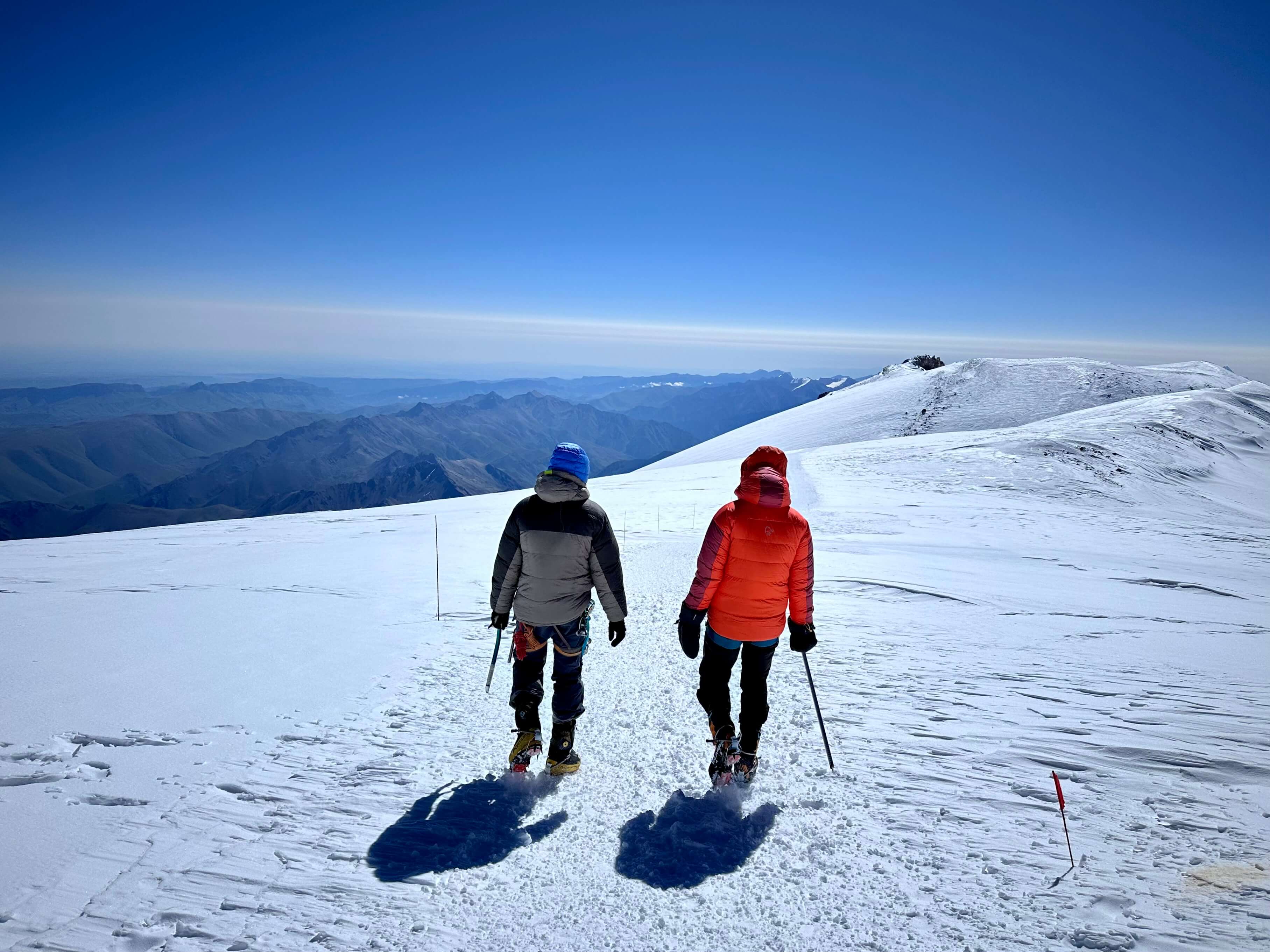
The descent from here was a slog. It felt a lot like an endless purgatory, where the end was never getting closer. You descend with long steps that slide for a fast pace, but I started to get a headache from the rattling of this fast movement. It’s something I’ve had to manage on peaks since, now understanding better the impact of fast, shaking movements at altitude. I was so happy to reach Garabashi Station around midday. Soon after we were descending on the cable car to town, staring up at the peak from the window and feeling fulfilled.
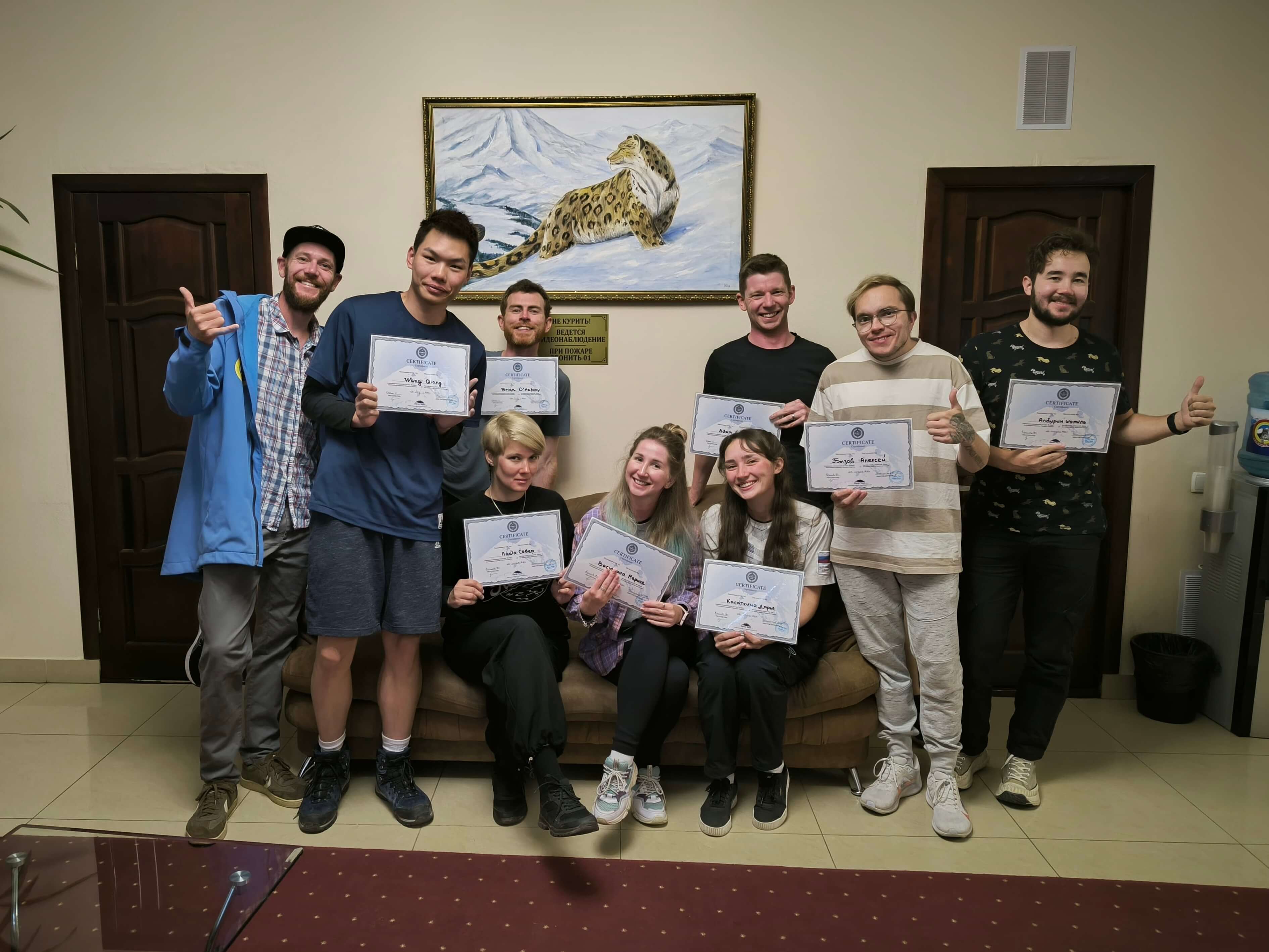
Since we had been delayed into our contingency day the trip wrapped up quickly. We were awarded certs by Viktor and had a celebratory dinner and drinks that night. We bought a few more souvenirs, then slept soundly. At 5:30am the next day, Pavel attempted another speed record along the airport road, to launch us back into the rhythm of flights and transfers. The last thing I saw of Russia was Elbrus in the distance, the sun rising behind it less than 24hrs after we had stood on top. Even conquered it looked no less imposing. This experience had felt like a month packed into a week, and I couldn’t have been happier with it.
Home via Istanbul
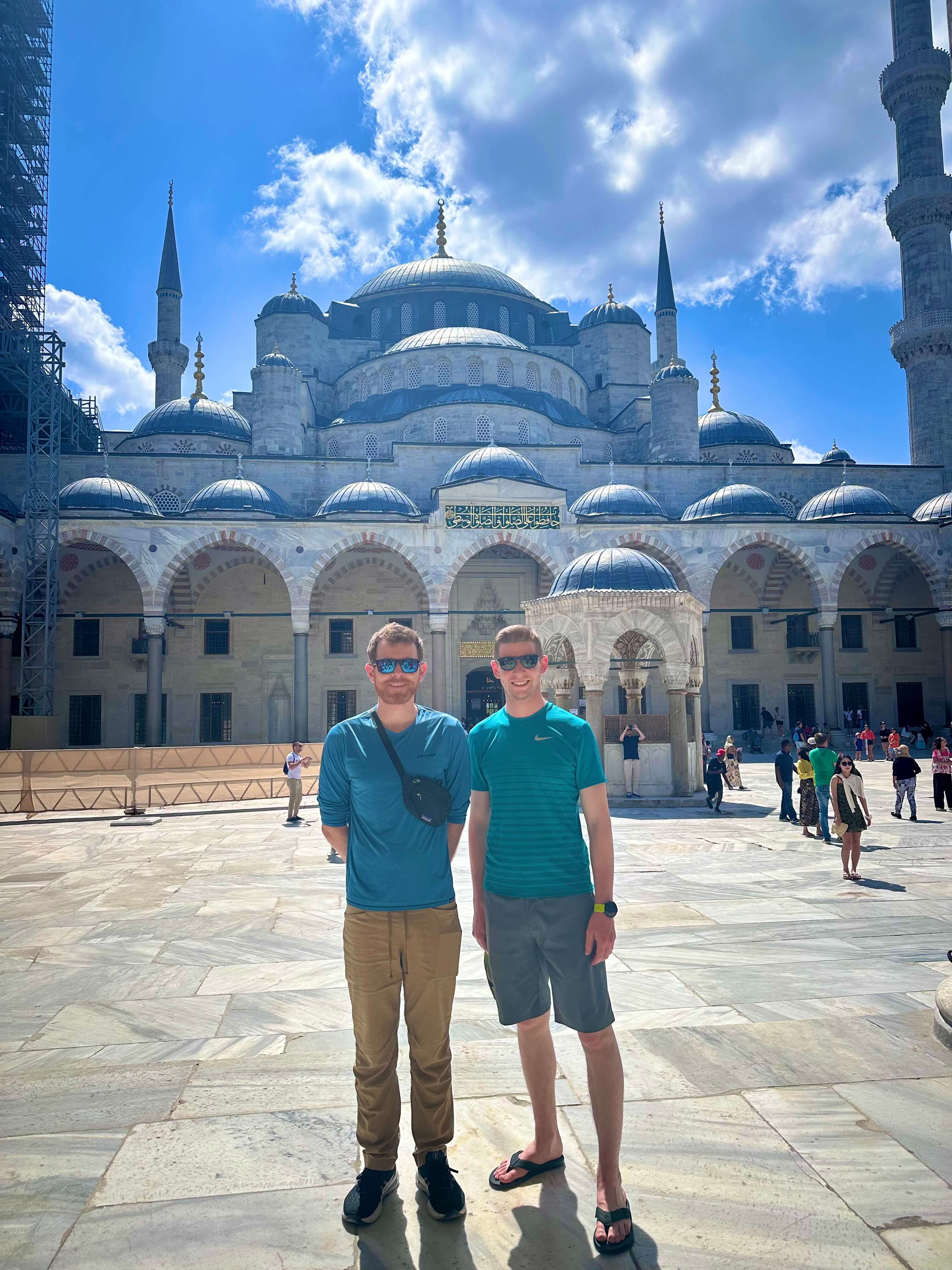
In hindsight our few days of celebrating would have been better spent in Moscow or Sochi while we already had visas, but Istanbul worked well too. Lots of good food and too many good drinks, watching the city from the roof of our hotel and touring the main sights. We visited some of the big mosques, a palace and went on an evening cruise with an open bar, but what I remember most is just walking along the coast. I could feel all the small aches and pains in my legs slowly recovering, like in the days after a marathon. Any light sunburn and chapped lips had time to heal as we rehydrated ourselves. From here, Adam flew directly to Malta for another short trip, while I headed home.
Afterthoughts
This is a perfect climb for anyone who’s summited Mont Blanc or Kilimanjaro and is looking to step up the difficulty. It was far cheaper than those climbs, but the Caucasus is no less stunning. It’s not one to be underestimated, but can be accessible with the right gear and preparation.
I’ve come to understand the snowcats a lot more. The climb is prohibitively long as we did it, and if that was the only option then success rates would plummet, along with demand. During the pandemic, guides shifted the demographics from global climbers to domestic tourists. The world has returned to normal, but the guiding industry of this mountain is still having to run more accessible trips to survive. It’s a personal decision for each climber, but I wouldn’t judge anyone on their decision to use it. Even with the snowcat, the remaining climb is far more difficult than summit night on Mont Blanc. It’s worth remembering that at 95% using it, the snowcat is the norm.
The ideal trip in my mind would be Moscow before and Saint Petersburg after, all booked on cheap Ryanair flights and with plenty of time allowed to see those cities. We planned our trip as best we could in the current situation but know now that we could have easily and safely spent more time. Adam & I both want to return at some point when things calm down. As for the climb itself, we couldn’t fault Elbrus Tours. They made the logistics easy and successfully got the whole group of 8 to the top.
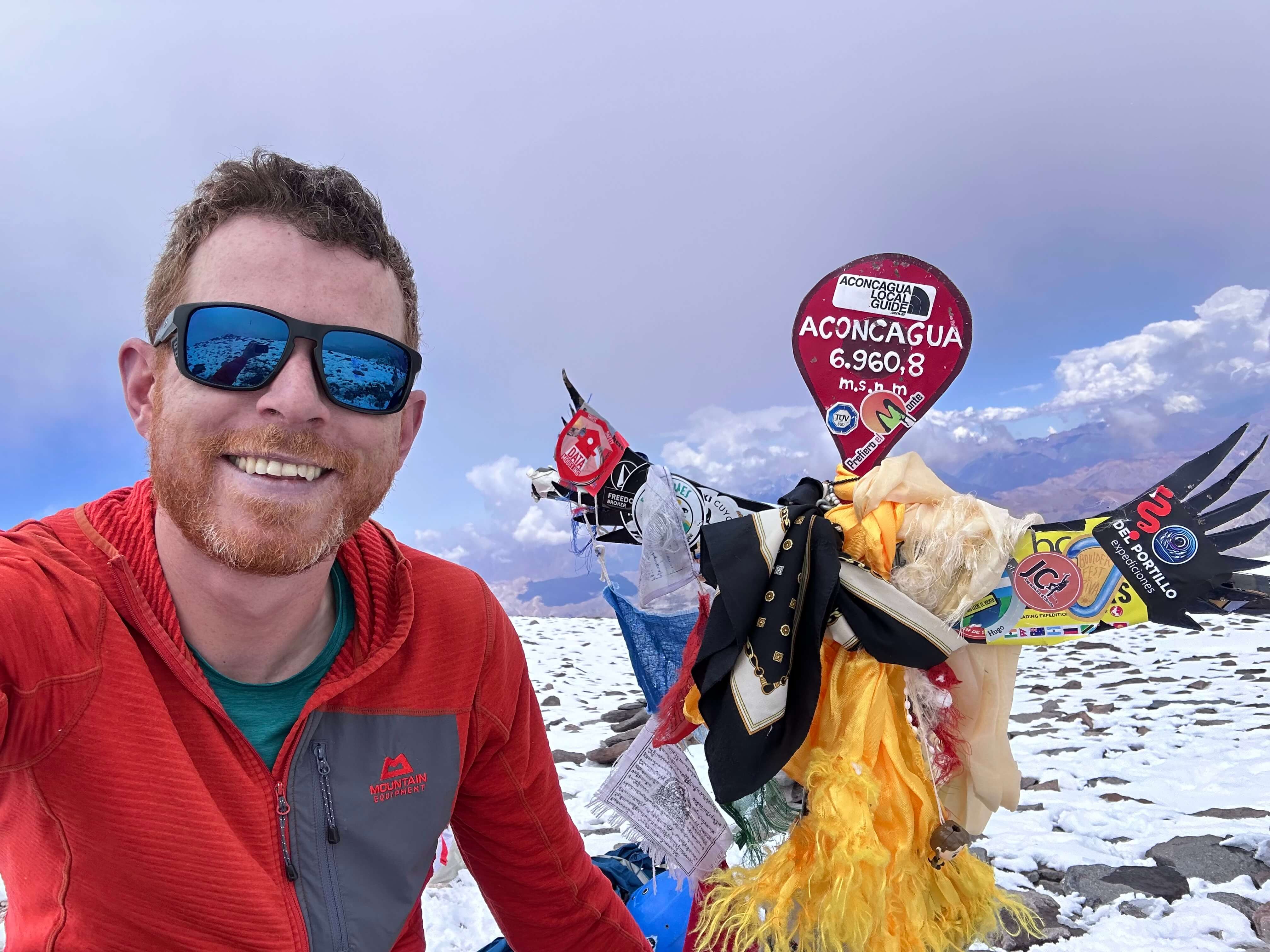
Our gear worked perfectly and our layers kept us warm on what was a cold summit night. It was a successful test run of what I would use on bigger climbs in the future. My eyes were already fixed to the next big climb: Aconcagua (6,961m), the highest point of South America.
Finally, Adam was the perfect team mate for this and I’m so glad it worked out for us to climb together. We were well aligned in motivation and fitness, which made preparations and the trip go smoothly. His ability to sleep anywhere is a superpower that allowed him make the summit night look easy. While I was battling through tiredness beside him, he helped me a lot. I knew from our experience on the Explorer Belt that he’s trustworthy in difficult situations, and ten years on nothing has changed. Everyday we took it seriously, controlled what we could, and worked through problems together. I’m excited to see what our next adventure will be.
What’s Next
The life I returned to in Ireland looked different now. I had left my job days before we departed, and put all my things into storage. This was to be the start of another year of full-time travel, set around many big goals that this climb had been a perfect launching pad for. Over five days I organised my things and packed the small bag that I would live out of for all that time. I celebrated my 29th birthday with those closest to me at a barbecue in the rain. Then, after tough goodbyes I boarded a flight to Mexico for the next adventure; Backpacking Central America.
Thank you for reading,
Brian
%20-%20The%20Highest%20Point%20in%20Europe)